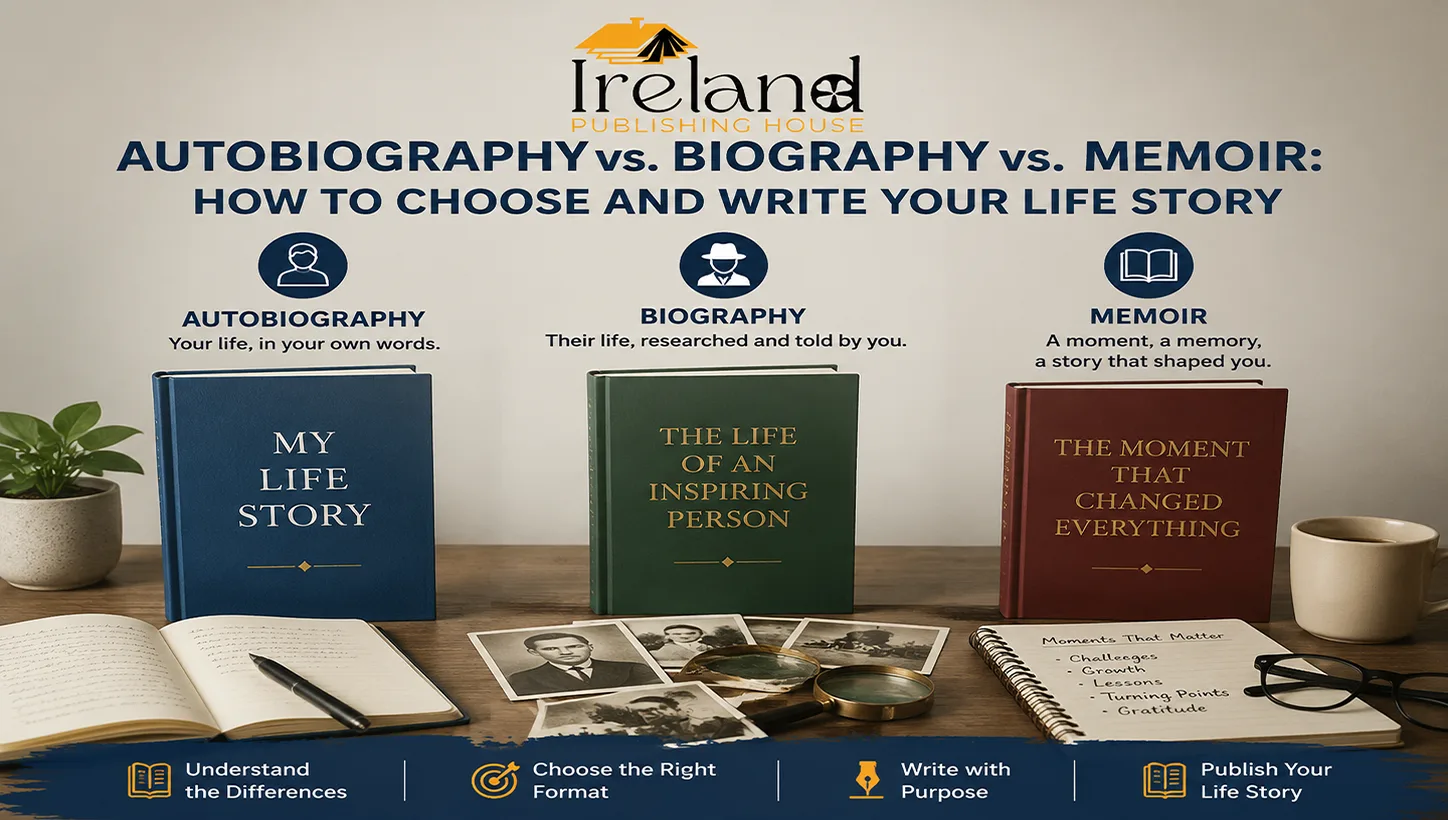
You've got a story worth telling. Maybe it's your own, start to finish. Maybe it's someone else's, the kind of life that deserves proper digging and research. Or maybe it's just one chapter, one turning point, one thing that changed everything for you. The trouble is, the moment you sit down to actually write it, a question stops you cold: what is this thing I'm making?
Autobiography, biography, memoir. Three words that get thrown around like they mean the same thing. They don't. And picking the wrong one doesn't just cause a headache with the title page, it changes how you structure the whole book, what point of view you write in, and what your reader expects from page one.
This mix-up trips up nearly every first-time life writer, and it's not your fault. Most advice out there tackles one form and ignores the other two, so you're left stitching together bits of guidance from a dozen different blogs, half of them years out of date. What you actually need is one place that lays all three out side by side, tells you which one fits your story, and then shows you how to write it properly.
That's what this guide does. By the end, you'll know exactly what separates an autobiography from a biography from a memoir, you'll have a proper comparison to settle any doubt, and you'll walk away with a step-by-step approach for whichever one you choose. We'll also get into publishing routes, common mistakes, and the legal side of writing about real people, because that last one catches out more first-time authors than anything else.
None of this is academic. The format you settle on decides how you research, how long the book runs, whether you're writing "I" or "she," and how much of yourself you're prepared to put on the page. Get it right early and the rest of the writing gets a lot easier. Get it wrong, and you'll find yourself three chapters in, wondering why the book won't come together the way you pictured it.
What Is an Autobiography, a Biography and a Memoir?
Let's start where the confusion actually lives: the definitions themselves. Once these are locked in, everything else gets easier. People use these three words as if they're interchangeable, and honestly, it's easy to see why. All three involve a real life, real events, and a story pulled from memory or research rather than imagination. But the similarities stop there, and the differences are exactly what decide how your book gets written.
What Is an Autobiography?
An autobiography is your whole life, written by you, more or less start to finish. It begins with your earliest memories (or your birth, if you're going the full distance) and works its way up to the present day, hitting the major events, the relationships, the wins and the losses along the way. You're the narrator and the main character, writing in first person, and the tone tends to be factual and reflective rather than built around one single emotional peak.
Nelson Mandela's Long Walk to Freedom is the textbook example. Anne Frank's The Diary of a Young Girl, while technically a diary, reads like an autobiographical account of a life lived in hiding. And Irish readers will know Angela's Ashes by Frank McCourt, a book that sits right on the line between memoir and full-life autobiography.
A proper autobiography is chronological (flashbacks aside), written in first person, and typically runs 80,000 to 100,000 words or more. If your goal is documenting your whole life for family, for the record, or because you're a public figure whose story matters to people beyond your own front door, this is your format. Just know you're signing up for a marathon, not a weekend project. That word count alone puts an autobiography closer to a full-length novel than a short project, so if you want a sense of how that length compares to fiction, our guide to how many words a novel should be is a useful reference point.
What Is a Biography?
A biography is someone else's life, written by you. You're the researcher, the interviewer, the person piecing together letters, records, and conversations into a narrative that's both factual and, inevitably, a little interpretive. Biographies can be authorised, meaning the subject cooperated and opened their archives to you, or unauthorised, meaning you built the picture without their blessing.
Walter Isaacson's Steve Jobs is the modern benchmark here, built on hundreds of hours of interviews with Jobs and the people who knew him best. A biography is written in third person, and it demands serious research; it can run anywhere from 80,000 to 120,000 words depending on how much ground you're covering.
The single biggest thing to get right: written permission from any living subject, and every claim checked against more than one source. One unverified fact can undo your credibility entirely, and under Irish law, the burden of proving a statement true falls on the person who wrote it. We'll come back to that.
Biography also comes in more shapes than people assume. There's the cradle-to-grave account that follows a subject from birth, and there's the narrower biography that zooms in on one defining chapter, a war, a career breakthrough, a scandal, and treats that period with the depth a full-life account simply can't afford.
What Is a Memoir?
A memoir isn't a shorter autobiography. It's a completely different animal. Where autobiography tries to cover everything, memoir zeroes in on one theme, one relationship, one stretch of time, and mines it for emotional truth rather than exhaustive fact. You're still writing in first person, but the structure is thematic or scene-driven rather than strictly chronological, and the goal is to make the reader feel the transformation, not just read about it.
Tara Westover's Educated is the standout modern example, tracing her journey from a survivalist upbringing to a PhD. On the Irish side, Nuala O'Faolain's Are You Somebody? remains one of the finest memoirs to come out of this country, weaving personal reckoning with a wider portrait of twentieth-century Ireland.
Memoir today tends to run tighter than autobiography, somewhere between 60,000 and 75,000 words, with the market increasingly rewarding books that don't pad themselves out. If you've got one powerful, contained story and you're willing to be vulnerable on the page, memoir is almost certainly your format. It also tends to lean the hardest on craft and language, so many memoirists borrow from poetry as much as from prose. If that's a direction you're drawn to, our piece on poetic techniques for Irish authors is worth a read before you start drafting scenes.
Autobiography vs. Biography vs. Memoir: The Full Comparison
Here's the whole thing laid out side by side, so you can settle any lingering doubt in one glance.
Feature | Autobiography | Biography | Memoir |
Authorship | Written by the subject (often with a ghostwriter) | Written by someone else about the subject | Written by the subject |
Scope | Entire life, birth to present | Entire life or a defined period, always researched | One theme, event or relationship |
Point of view | First-person | Third-person | First-person |
Emotional focus | Factual, reflective | Balanced and analytical | Deeply personal |
Structure | Chronological | Chronological or thematic | Thematic, scene by scene |
Typical length | 80,000–100,000+ words | 80,000–120,000 words | 60,000–75,000 words |
Primary goal | Document a life for legacy | Interpret a life through research | Explore one experience and its impact |
That table alone should settle most of the confusion. But definitions only get you so far. The real decision comes down to feel, so let's dig into each form properly.
A Closer Look at Each Genre
Autobiography: The Legacy Project
Think of autobiography as a monument. You choose it when you want the full record preserved, for your family, for history, or for a public audience that already knows your name. But a good one isn't a list of dates. The strongest autobiographies weave a proper narrative that reveals character, not just chronology.
You'd reach for this format if you've lived a long and eventful life you want documented in full, if you're a public figure whose story carries public interest, or if you're building something for future generations to inherit. There's room for variation here too. A traditional autobiography runs the whole life in order, the way Malcolm X's does. A thematic one, like Michelle Obama's Becoming, organises around ideas rather than strict timeline. And an autobiographical novel, Jack Kerouac's On the Road being the classic case, fictionalises the author's own life while staying recognisably true to it.
If you've got the story but not the writing chops, hiring a ghostwriter is a completely normal move, and one plenty of public figures take. The trick is finding someone who can actually sound like you on the page rather than flattening your voice into something generic. Ireland Publishing House's ghostwriting team specialises in exactly that kind of voice-matching work, and for anyone leaning toward the fictionalised route, their fiction ghostwriting service covers that too.
Biography: The Researcher's Craft
Biography asks something different of you: the patience of a historian and the instincts of a storyteller. You're not simply reporting facts; you're interpreting a life and finding the thread that makes it mean something. Whether your subject is a historical figure or someone still very much alive, your credibility rests entirely on how thorough and balanced your research is.
This is your format if you're genuinely fascinated by someone else's story, you've got access to primary sources like letters or interviews, and you're willing to spend months, sometimes years, getting it right. There's real variety within biography too: authorised works written with the subject's cooperation, unauthorised ones written without it (and often more critical as a result), historical biographies built from archives, and collective biographies that follow multiple people bound by one theme, the way The Immortal Life of Henrietta Lacks blends personal story with the history of science.
The temptation every biographer has to resist is hagiography, painting the subject as flawless. Readers trust a writer who shows the whole person, failures included.
Memoir: The Art of Emotional Truth
Memoir is the most intimate of the three forms. It's not really about what happened. It's about what it felt like, and what it means to you now, looking back. You're asking readers to step into one specific, transformative stretch of your life, and you earn their trust through honesty and craft, not just disclosure.
Reach for memoir when you've got one powerful story that changed you, when you want to explore a theme like grief or identity or recovery through what actually happened to you, and when you're genuinely comfortable being emotionally exposed on the page. There are subgenres worth knowing here too. Coming-of-age memoirs, like Jeannette Walls's The Glass Castle, focus on formative years. Transformational memoirs, like Cheryl Strayed's Wild, centre on one life-altering journey. Thematic memoirs, such as Michelle Zauner's Crying in H Mart, explore a single subject, in her case food, grief and identity, through personal experience. And hybrid memoir, blending personal narrative with essay or cultural commentary, is one of the fastest-growing shapes the form is taking in 2026.
The market right now genuinely rewards authentic, diverse voices willing to experiment with structure. Don't be afraid to break from strict chronology. Just keep the emotional core of the book front and centre the whole way through.
How to Write an Autobiography
Writing your full life story is a serious undertaking, so a bit of structure goes a long way.
Start with your purpose. Before you write a single line, work out why you're doing this. Family record? Public legacy? A grandchild who'll never meet you otherwise? Your answer shapes everything from tone to how much detail you include.
Gather everything first. Journals, letters, photographs, old emails, anything with a date on it. Talk to relatives who remember things you've forgotten. A searchable note-taking tool earns its keep here, since you'll be hunting for specific memories constantly once you start drafting.
Build a timeline before you build an outline. Map your life in order, marking the turning points and the recurring themes. This becomes the skeleton your chapters hang off. Once that's done, break it into logical chapters, childhood, adolescence, career, family, and note the key scenes and emotional takeaway for each. Fifteen to twenty-five chapters is typical for a full-length autobiography.
Draft fast, edit later. Set yourself a daily word count, five hundred to a thousand words, and push through without stopping to polish. The first draft's only job is to exist. Once it does, read it back as a reader would, hunting for pacing problems and anything that repeats itself without adding value.
Fact-check, then polish. Verify your dates and names, layer in the sensory detail that brings scenes to life, and only then start thinking about grammar and line-level editing. This is also when you should be thinking about the legal side, which we'll cover properly further down. When you're ready for that final pass, a professional editing service catches the things you'll have gone blind to after months with the same manuscript, and a dedicated book proofreading pass afterwards is what separates an amateur-looking manuscript from a genuinely publishable one.
How to Write a Biography
Biography runs on research, so the process looks a bit different from the start.
Choose your subject and your angle. Passion matters, but so does asking what fresh angle you're actually bringing. A little-known period of someone's life? A reinterpretation of events everyone thinks they already understand? Nail your thesis early, because it'll guide every research decision after this.
Go deep on primary sources. Letters, diaries, interviews, public records, anything that puts you closer to the actual events rather than someone else's summary of them. For living subjects, always get written permission and interview them more than once. For historical figures, cross-check facts against at least two independent sources before you trust them.
Decide your structure. Chronological is the safest choice, but a thematic approach can be far more engaging if your subject's life has clear through-lines worth following, career, relationships, a defining obsession.
Write it like a story, not a report. Open with a scene that pulls the reader in, build tension, show growth. Even though every word has to be factual, dry textbook prose is the fastest way to lose a reader who picked up your book expecting a story.
Balance fact with interpretation, and address the legal side properly. Your interpretation is what makes the biography yours; just be transparent about where you're reading between the lines. Before you go anywhere near publication, review the manuscript for anything that could be defamatory or a privacy violation, and if your subject is alive, give them the chance to respond to anything sensitive.
How to Write a Memoir
Memoir runs on emotional truth rather than comprehensive fact, and the process reflects that.
Nail your core theme first. Not the plot, the emotional journey underneath it: learning to forgive an absent parent, finding your identity after a loss. If you can't say it in one sentence, you're not ready to start writing yet.
Pick scenes, not a timeline. You don't need to cover everything, and trying to will dilute the book. Choose ten to fifteen scenes that actually illustrate your theme, each one showing a moment of change or realisation.
Outline by theme, not chronology. Group your scenes by emotional arc rather than the order they happened. A memoir about recovery might move through sections like "The Fall," "The Bottom" and "The Climb," which keeps the focus squarely on transformation rather than a diary-style march through events.
Write in scenes, with real sensory detail. Show, don't tell. Dialogue, setting, internal monologue, the things that put a reader inside a moment rather than watching it from a distance. This is where memoir borrows most heavily from fiction technique, and a bit of figurative language goes a long way toward making a scene stick in a reader's mind rather than just passing through it.
Find your voice and read it aloud. Memoir voice is conversational but carefully built. If a sentence sounds stilted when you read it out loud, cut it.
Handle the truth honestly. Emotional truth doesn't mean fabrication. If you've compressed a timeline or merged two people into one composite character for the sake of the story, say so plainly in an author's note. That single act of transparency protects both your credibility and your relationships with the people in the book.
Get the right kind of feedback before you publish. Memoir often involves other people, so think carefully about how they'll feel reading it, and change identifying details where you need to. If your story touches on marginalised communities or trauma, a sensitivity reader isn't a censor; they're a collaborator who helps you tell the story with more awareness.
Which Format Is Right for You?
Still torn? Run through this quickly.
Are you writing about your own life? If not, you're writing a biography. If yes, ask the next question: do you want to cover your entire life, birth to now? If yes, that's an autobiography. If no, you're looking at a memoir.
One more test worth applying: is your primary goal to document facts for the record, or to explore one emotional transformation? Facts and legacy point to autobiography. A single emotional arc points to memoir.
If you're still on the fence, try writing the same scene twice, once in memoir style and once as if you were a biographer describing yourself from the outside. Whichever version feels more natural to write is usually your answer. The format should serve the story, never the other way round.
It's also worth admitting that plenty of successful books sit somewhere between these categories. Frank McCourt's Angela's Ashes is routinely shelved as both memoir and autobiography, because it covers a defined stretch of childhood with the emotional intensity of memoir while still reading, in places, like a fuller life account. Don't let the labels paralyse you. Pick the closest fit, start writing, and let the finished book tell you if it needs a different name.
Publishing Your Life Story in Ireland
Manuscript finished. Now what? The good news is Irish writers have more genuine paths to publication in 2026 than at almost any point before.
Traditional publishing still carries prestige for autobiography and biography, though you'll need an agent, a proposal, and a fair amount of patience. Memoir from an unknown writer faces a tougher market, but a strong personal platform, social following, speaking work, a recognisable name in your field, can tip things in your favour. Irish publishing houses like Gill Books, New Island Books, Lilliput Press and Penguin Ireland all run dedicated non-fiction and memoir lists worth researching directly, alongside the traditional route through a literary agent. Whichever route you approach, agents and publishers will almost always ask for a short synopsis before they'll look at a full manuscript, and even life writing benefits from the same discipline covered in our guide on how to write a synopsis.
Self-publishing has properly shed its old stigma, and it's a genuinely strong choice for family autobiographies, niche biographies, or memoirs with a built-in readership already following your work. You keep full control of your timeline, your cover, and your profits, but you also carry every cost yourself. If that's your path, our Irish self-publishing roadmap walks through what that actually involves here, and our piece on the cost to self-publish a book in Ireland breaks down the numbers realistically.
Hybrid publishing sits between the two: you pay for services but keep more rights and royalties than a traditional deal offers. Vet any hybrid publisher carefully, since some operate closer to a vanity press than a genuine partner. Look for a track record of proper retail distribution.
Whichever route you choose, the practical side of publishing still has to happen. That means formatting your manuscript so it actually looks like a professional book rather than a Word document, sorting the design of a cover that does your story justice, and, for family-focused autobiographies especially, considering book illustration for photo inserts or custom artwork. If you'd rather have your book widely read than sat in a drawer, marketing support and a proper author website give readers somewhere to actually find you. And once the digital side is sorted, book printing turns the whole thing into something you can hold.
Three trends are worth watching as you plan. Memoir keeps booming, with shorter, tighter manuscripts around 60,000 words gaining real traction. Biography is going multimedia, with enhanced e-books now including embedded interviews and interactive timelines, and plenty of authors adding a short book video trailer or a full audiobook version to reach readers who'd rather listen than read. Amazon remains a major route to readers too, and getting the technical side right through proper Amazon Kindle publishing support saves a lot of trial and error. And autobiography is increasingly a legacy project, with more people self-publishing heirloom-quality family books complete with photo inserts and custom design work; some even reshape their story into a children's book format so grandchildren can grow up with it. Whatever direction you take, a joined-up publishing process behind you makes every one of these options far less daunting.
Common Mistakes to Avoid
Every form has its own trap, and even experienced writers fall into them.
For autobiography, watch for the "and then" problem, a dull march through events with no narrative pull. Fix it by choosing scenes that reveal character rather than simply ticking off milestones. Oversharing is the second trap; your reader doesn't need your entire family tree, only what serves the portrait you're building. And a lack of reflection, facts without insight, is the third. After every major event, ask yourself what you actually learned from it, and put that on the page.
For biography, hagiography is the big one, painting your subject as flawless. Include the failures and contradictions; that's what makes a portrait believable. Research gaps, relying on one source or an unverified claim, will undo you fast, so triangulate everything against at least two independent sources. And a dry, academic tone forgets that biography is still storytelling. Read narrative non-fiction writers like Erik Larson or David McCullough if you need a reminder of how it's done.
For memoir, the most common trap is using the page as therapy rather than crafting an actual story; every scene needs to serve the theme and move things forward, not just process feelings. Inconsistent voice, drifting between formal and casual or between past and present tense, breaks reader trust. And legal blind spots, exposing private details of real people without consent, are the mistake that causes the most damage after publication. Change names, use composite characters where appropriate, and get proper advice if you're at all unsure.
It's worth saying plainly: the most common memoir mistake of all is confusing emotional truth with factual invention. Readers will forgive a compressed timeline if you're upfront about it in an author's note. They won't forgive discovering, after the fact, that a pivotal scene simply didn't happen the way you wrote it.
Ethics and Legal Considerations for Life Writers
Writing about real people is a genuine responsibility, and this is the section most guides skip entirely.
On privacy and consent: you have every right to tell your own story, but the moment other people appear in it, their privacy matters too. Get written permission from key individuals, especially anywhere sensitive information is involved, and if someone has passed away, think about how their family will feel reading it. For biography specifically, written consent from a living subject is non-negotiable if you want the work to be authorised. Unauthorised biography is legally possible without permission, but it carries real risk if you include anything defamatory.
Ireland's defamation law is governed by the Defamation Act 2009, as reformed by the Defamation (Amendment) Act 2026, which took effect from March of this year. Truth remains a defence, but proving it can be costly, and the burden of proof still sits with the writer, not with the person taking issue. The 2026 changes mostly affect court procedure rather than the day-to-day advice for life writers, but a few points are worth knowing: High Court defamation cases are no longer heard by a jury, and there's now a simplified "public interest" defence for anyone publishing on a matter of genuine public concern. For a memoirist or biographer, the practical takeaway hasn't changed much: avoid exaggerating negative details, avoid presenting opinion as fact ("he was a thief" versus "in my opinion, his actions were dishonest"), and be especially careful using real names for minor characters who never agreed to appear in your book. Our guide to copyright law covers the related question of what you can and can't quote or reproduce from other sources, which trips up plenty of first-time memoirists who lean on old letters, diary extracts or song lyrics.
On accuracy: biographers live and die by verification, with every date, quote and event checked against primary sources wherever possible. Memoirists get more latitude with emotional truth but still can't fabricate events outright; if you've compressed a timeline or merged people into a composite character, say so in an author's note. Autobiographers should remember memory is fallible, cross-check your own recollections against journals and family members, and simply acknowledge the gaps you can't fill.
And if your story touches on marginalised communities or genuinely traumatic events, a sensitivity reader is worth the investment. They're not there to censor your voice; they're there to flag blind spots you genuinely can't see from inside your own experience.
One more Irish-specific point worth flagging: if you've recorded interviews or collected personal details from people for a biography or a family memoir, GDPR applies to how you store and handle that information, not just how you write about it. It's a good habit to keep recordings and notes secure, tell interviewees plainly what you intend to do with what they've shared, and delete anything you no longer need once the book is finished.
Tools and Support That Make Life Writing Easier
The right support at the right stage saves you months of frustration. For research and organisation, a searchable note-taking app keeps interview transcripts and stray memories in one place, while a visual timeline tool helps you map character arcs and turning points, particularly useful for biography and memoir alike. For the drafting stage itself, long-form writing software with a proper corkboard view lets you rearrange chapters without losing your place, and a free, collaborative document tool works well for sharing early drafts with beta readers.
For editing, a grammar assistant catches the obvious slips, but nothing replaces a professional pass, and it's worth setting any software you use to Irish or British English rather than the American default most tools ship with. Small punctuation habits matter more than people expect too; getting comfortable with when to use an em dash versus an en dash will tidy up your prose long before it ever reaches a professional editor.
If you'd rather not manage every stage yourself, that's precisely where a full-service partner earns its place. From ghostwriting and developmental editing through to cover design, formatting, illustration, marketing and print, a team that's handled hundreds of Irish life stories will spot the gaps you can't see in your own manuscript. It also means you're not learning the publishing process from scratch while trying to finish a deeply personal book at the same time, which is a lot to carry alone.
Your Story Is Worth the Work
You've now got the full picture: what separates these three forms, how to write whichever one fits your story, and how to navigate the publishing and legal side without tripping over the parts nobody warns you about. Whether you're writing a sweeping autobiography, a carefully researched biography, or a memoir built around one transformative stretch of your life, the only thing left to do is start.
Every published author sat exactly where you're sitting now, with a story and a blank page in front of them. The only difference is they opened the document. So do that. Your story deserves telling, and now you actually know how. If you'd like a hand at any stage of the process, Ireland Publishing House works with life writers across the country from that very first draft through to a finished book on the shelf.