You've typed "The End" on your manuscript, and there's a small, quiet thrill in that. Months, maybe years, of work, finally sitting there as a finished thing. And then, almost immediately, a different feeling creeps in. A nagging little question that won't leave you alone: is it the right length?
You've probably heard the horror stories by now. Agents rejecting queries on word count alone, before they've read a single line of your actual writing. Blog posts contradicting each other, one swearing your novel must be 80,000 words, the next insisting 120,000 is perfectly fine. The more you read, the less sure you feel. In 2026, literary agents are reporting that debut novels over 100,000 words are facing real market resistance. But that doesn't mean you should panic and start hacking your story to pieces.
Here's what this guide is going to do. It cuts through the noise. You'll get up-to-date, genre-specific word count targets, straight answers about what agents and editors are actually looking for, and practical editing techniques to shape your manuscript into a length the market will welcome, without sacrificing the heart of what you wrote. Whether you're chasing a traditional deal or planning to self-publish, you'll finish this article knowing exactly what number to aim for and how to get there.
Your manuscript's word count isn't just a number. It's a signal to agents and readers about the kind of story you're telling and whether it fits what they expect. Once you understand that, the whole thing stops feeling like a trap and starts feeling like a tool you can use.
Ready to turn word count anxiety into a strategic advantage? Let's get into it.
What Counts as a Novel? Definitions and Thresholds
Before we talk numbers, it's worth defining what we're actually measuring, because the words "novella," "novel," and "epic" get thrown around loosely, and the distinctions matter more than you'd think.
Industry organisations like the Science Fiction and Fantasy Writers Association classify works by word count, and the broad agreement looks like this:
Novella: 20,000–40,000 words
Novel: 40,000 words and above
Epic: typically over 150,000 words, though "epic" is more a marketing term than a strict category
Most commercial fiction lands somewhere between 70,000 and 100,000 words. Now, technically, a 40,000-word book is a novel. Nobody can take that label away from you. But here's the catch: readers and publishers usually expect more substance than that, particularly in genres like fantasy or historical fiction where the world itself needs room to breathe. A 40,000-word fantasy will often feel thin to the very readers you're trying to reach. Understanding where these thresholds sit helps you position your work correctly from the moment you write your first query letter.
If you're still weighing up whether what you've written is a novella or a full novel, it's a distinction worth getting right early, and there's plenty more to unpack in the difference between a novella and a novel than word count alone.
One last thing before we move on, and it's the single most freeing piece of advice in this whole guide: don't obsess over word count in your first draft. Seriously. Your only job in a first draft is to get the story down. You revise with length in mind later, during editing. Worrying about your word count while you're still drafting is like worrying about the paint colour while you're still pouring the foundations.
Word Count by Genre: A Detailed Breakdown
Right, this is the part you came for.
The single most important factor in determining your novel's ideal length is its genre. It's not arbitrary. Readers come to each genre with deeply ingrained expectations about pacing, depth, and scope, and those expectations have been shaped by decades of books that came before yours. A romance reader and an epic fantasy reader are looking for completely different experiences, and length is part of how those experiences are delivered.
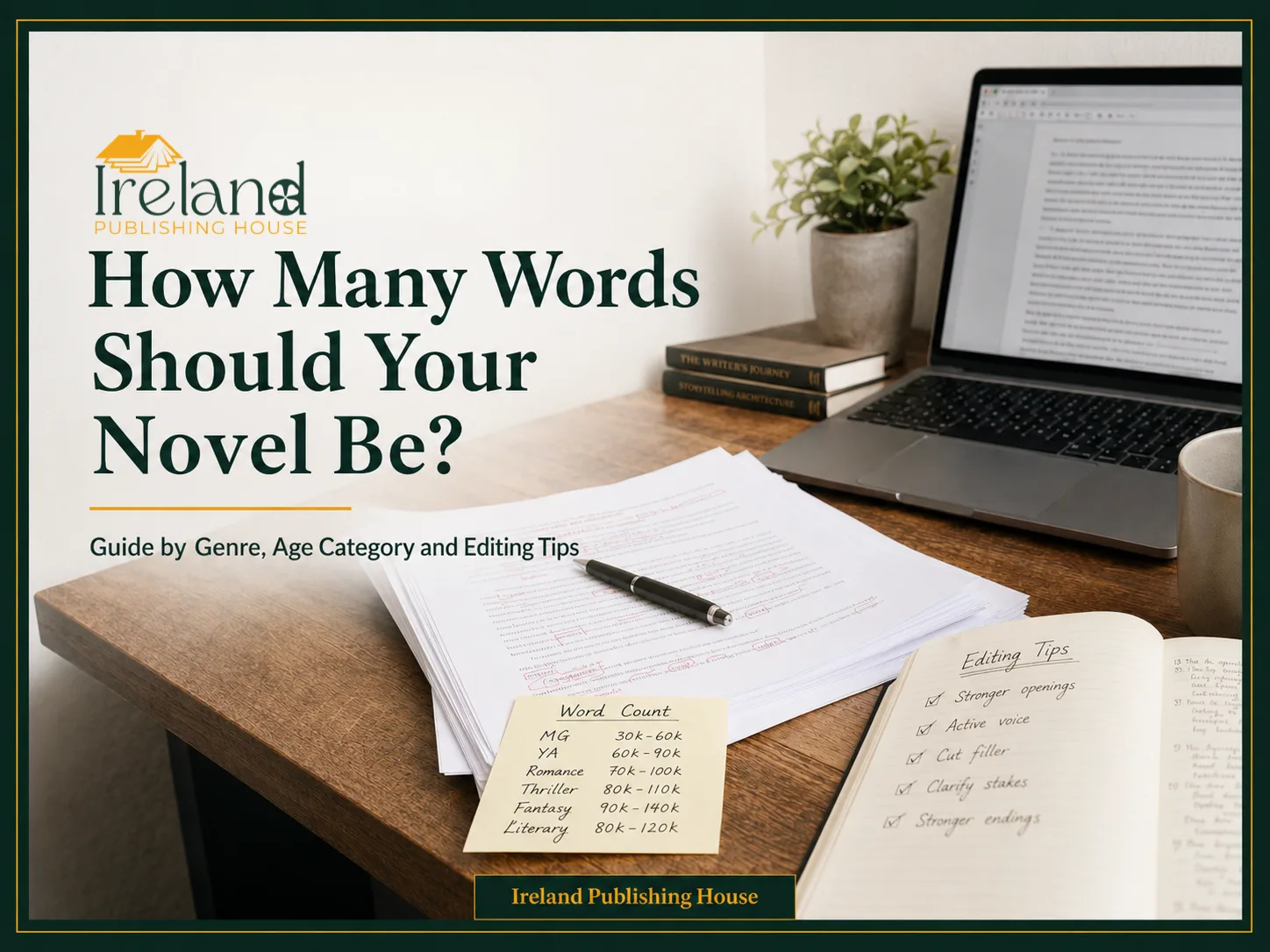
The table below pulls together 2026 data from literary agents, industry reports, and current market analysis to give you a clear target for each genre and age category.
Genre / Age Category | Typical Range | Ideal Debut Target | Notes & 2026 Trends |
Literary Fiction | 80,000–100,000 | 80,000–95,000 | Trend toward leaner manuscripts; some acclaimed titles run shorter, but agents still expect a full arc. |
Commercial Fiction | 70,000–100,000 | 80,000–90,000 | Bestsellers often cluster around 90,000–95,000; publishers want tight, fast-paced reads. |
Mystery / Thriller | 70,000–90,000 | 75,000–90,000 | Pacing is everything; shorter chapters and lean prose are expected. Cosy mysteries can sit at 70–75k. |
Romance | 50,000–100,000 | 70,000–90,000 | Category-dependent; contemporary romance often shorter, historical can run longer. |
Science Fiction | 90,000–120,000 | 100,000–110,000 | Worldbuilding adds length, but publishers want tighter manuscripts; avoid info-dumps. |
Fantasy | 90,000–130,000 | 100,000–120,000 | Epic fantasy can run longer, but debuts over 120,000 words face resistance. |
Young Adult | 50,000–80,000 | 55,000–80,000 | YA fantasy can stretch to 90,000; contemporary often shorter than fantasy. |
Middle Grade | 25,000–55,000 | 30,000–45,000 | Lower middle grade (25,000–35,000); upper middle grade (45,000–55,000). |
Novella | 20,000–40,000 | 30,000–40,000 | Enjoying a commercial revival in 2026, especially in literary and sci-fi; a viable debut option. |
A few things worth drawing out from that table.
Notice how the debut targets almost always sit at the lower-to-middle end of the typical range. That's deliberate, and it's not the industry being fussy for the sake of it. For a debut author, a leaner manuscript signals discipline. It tells an agent you know how to self-edit, that you can tell a complete story without padding it out. Once you've got a track record and a readership, you earn the freedom to go longer. But your first book is not the place to test the limits.
There's also a format dimension that often gets overlooked. Word count expectations shift depending on how readers will consume your book. Audiobooks tend to favour tighter pacing, because listeners can't skim the way print readers do, so a slow patch feels far more punishing in audio. Print, by contrast, gives readers permission to linger over a descriptive passage. If you're planning a multi-format release, it's worth thinking about how your manuscript's length translates across each medium, because what feels perfectly paced on the page can drag in your ears.
If your manuscript has landed outside the range for your genre, don't despair, and definitely don't start slashing or padding in a blind panic. We'll get into exactly how to fix both problems further down. The number on the screen is the starting point of a conversation, not a verdict.
Traditional Publishing vs. Self-Publishing: Different Rules?
The publishing path you choose dramatically affects how much flexibility you have with word count. The same 130,000-word manuscript can be a liability in one context and a non-issue in another, so it's worth understanding both sides.
Traditional Publishing: The Gatekeepers' Perspective
In traditional publishing, agents and editors use word count as a quick filter, and it's easy to feel hard done by when you first realise that. A 200,000-word debut fantasy signals "unpolished" or "self-indulgent" before anyone's read a word, even if the writing inside is genuinely brilliant. It feels unfair, and in individual cases it sometimes is. But there's hard logic behind it.
Longer books cost more to produce. More paper, higher printing costs, heavier shipping, more shelf space. Every one of those is a financial risk, and publishers are far more cautious about taking that risk on an unknown author than on an established name with guaranteed sales. So in 2026, the reality is straightforward: anything over 100,000 words from a debut author tends to attract extra scrutiny. Your story has to work harder to justify every thousand words above that line.
Self-Publishing: Flexibility with Reader Expectations
Self-publishing gives you more leeway, but don't mistake "more leeway" for "no rules." Indie authors aren't off the hook, they've just got a different hook.
On platforms like Kindle Unlimited, authors are paid by pages read, which means a longer book can technically earn more, as long as readers actually stick with it to the end. And that's the whole catch right there. A bloated book that loses readers halfway through doesn't just earn less, it actively damages your also-boughts and tanks your reviews, which hurts every book you publish afterwards. When you research the top-selling indie titles in your genre, you'll notice they tend to cluster around the same lengths as their traditionally published counterparts. That's not a coincidence. Reader expectations don't change just because you've skipped the gatekeepers.
Whichever route you take, setting clear word count goals and tracking your progress against them makes the whole process far less stressful. Tools like Reedsy Studio or Scrivener let you set targets and watch yourself close in on them, which is oddly motivating when the finish line feels distant. And if you're weighing up the indie route in particular, it helps to have the full picture mapped out, which is exactly what our Irish self-publishing roadmap is there for.
How to Cut Your Manuscript Down to Size
So your manuscript is over the ideal range. First things first: don't panic. Cutting is not the same as losing your story. Done well, strategic tightening sharpens your prose and improves your pacing. Most overlong manuscripts aren't overlong because the story is too big. They're overlong because the telling is loose. Here's how to tighten it methodically.
Step 1: Reverse Outline Your Manuscript
This one's a game-changer, and it's the technique professional editors reach for first. Once your draft is done, go back and create a scene-by-scene outline of the book as it actually exists, not as you imagined it. For each scene, ask one ruthless question: does this advance the plot or develop a character? If the honest answer is no, flag it for cutting or condensing. The reverse outline forces you to see your manuscript's structure clearly, stripped of all the lovely prose that's been hiding its weak points.
Step 2: Identify and Cut Redundant Scenes
Now look for repetition. Two conversations that reveal the same piece of information. Multiple travel sequences that all do the same narrative job. Scenes that exist only because you enjoyed writing them. Combine the duplicates or cut the weaker one outright. You'll often find your story tightens up without losing anything a reader would miss.
Step 3: Tighten Prose at the Sentence Level
This is where the real word count savings hide, a few words shaved from every sentence adds up faster than you'd believe across an entire novel.
Cut filter words like "she saw," "he heard," "I felt." Instead of "she saw the door creak open," just let the door creak open. It pulls the reader straight into the scene.
Replace weak verb-and-adverb pairs with one strong verb. "Walked quickly" becomes "hurried." "Said loudly" becomes "shouted."
Eliminate dialogue tags wherever it's already obvious who's speaking.
Use contractions. "Do not" becomes "don't." It reads more naturally and trims the count.
Editing tools like ProWritingAid and Hemingway Editor are genuinely useful here. They highlight wordy sentences, passive constructions, and hard-to-read passages, which makes line-level tightening faster and a good deal more objective than relying on your own tired eyes.
Step 4: Use Beta Readers to Flag Slow Sections
Before you submit anything, hand your manuscript to beta readers with one specific instruction: mark every spot where your attention wandered. Don't ask them to be polite about it. Those wandering-attention moments are almost always where your word count bloat is hiding, and a fresh reader will spot them instantly where you've gone blind to them.
There's a smarter way to think about all this trimming, and it's worth naming. Call it the "Goldilocks" method. Instead of blindly chopping words to hit a number, you weigh up your story's complexity, its pacing, and the market data for your genre, then find the length that feels just right. Not rushed. Not bloated. The right size for the story you're actually telling. And if cutting your own work feels impossibly hard, that's completely normal, it's exactly the point where many authors bring in a professional editing pass to do what fresh, experienced eyes do best.
How to Expand a Too-Short Novel
The opposite problem is just as common, and just as fixable. A manuscript that falls short of genre expectations often feels thin or rushed, like a meal that left you still hungry. The key to fixing it is one word: substance, not filler. Padding is obvious, and readers can smell it. Genuine depth is invisible, it just makes the book feel richer. Here's where to find it.
Identify underdeveloped subplots
Look at your secondary characters. Does one of them have a journey that's been hovering in the background, never quite given its moment? A subplot that mirrors or contrasts your main plot can add real depth and grow your word count organically, because it's earning its place in the story rather than just taking up room.
Deepen your character arcs
Find the moments where a character's internal conflict could be explored more fully. Add scenes that show their growth, their setbacks, the relationships that shape them. This is the kind of expansion readers actively want, because it's the emotional meat of the book.
Enrich your scenes with sensory detail
Go through scene by scene and ask: have I engaged all five senses here? What does this room smell like? What can the character hear in the background? Specific, concrete sensory detail can expand a scene by hundreds of words while making it far more immersive, which is the best kind of word count, the kind that improves the book.
Add a new perspective or timeline
If your story is told from a single point of view, consider whether a second perspective might shed fresh light on events. Or weave in a parallel timeline that deepens the main narrative. This is a bigger structural move, so handle it with care, but when it works, it can transform a slim manuscript into something layered and substantial.
A quick word on why this matters from the reader's side. A too-short novel often feels rushed, and a rushed ending leaves readers vaguely unsatisfied even when they can't say why. Adding meaningful content, never filler, increases immersion and emotional payoff. It makes the book feel worth the price and worth the time, and that feeling is what turns a reader into someone who buys your next book too. Setting incremental goals with a tool like Pacemaker Planner can keep the expansion process steady, so you're building depth methodically rather than scrambling to hit a number.
Chapter Length: How Many Words Per Chapter?
Chapter length is a pacing tool, not a rigid rule, so let go of any idea that there's a "correct" chapter length you're failing to hit. There isn't. But understanding the norms gives you genuine control over how your reader experiences the book.
Average Chapter Length by Genre
These are rough working averages, useful as a sense-check rather than a law:
Thrillers: 1,500–3,000 words. Short, punchy chapters keep the pages turning, which is exactly the effect you want in a thriller.
Literary Fiction: 2,000–5,000 words. More reflective, often longer, with room for the prose to slow down and breathe.
Fantasy / Sci-Fi: 2,500–5,000 words. Worldbuilding sometimes needs longer chapters to establish a scene fully.
Young Adult: 1,500–3,500 words. Fast-paced and accessible, matching how the audience reads.
The Psychology of Chapter Breaks
Here's the part most writers underestimate. Chapters act as mental rest stops for your reader. They're natural pausing points, and how you handle them shapes whether someone reads "one more chapter" at midnight or puts the book down for the night. End a chapter on a cliffhanger or a moment of tension, and you compel the reader to start the next one almost against their will. Consistent chapter length creates a comfortable rhythm, but a bit of occasional variation stops that rhythm becoming monotonous.
How to Vary Chapter Length for Pacing
Use short chapters, under 1,000 words, for high-action sequences or to inject sudden urgency. A short, sharp chapter makes the heart beat faster.
Use longer chapters for complex scenes that need sustained immersion, where breaking the spell would cost you.
Alternate between the two to create a natural ebb and flow, tension and release, across the whole book.
Scrivener's word count statistics and session tracking make it easy to monitor your chapter lengths as you write, so you can spot imbalances before they become a problem in revision. And if you want to see how the masters handle this, look at the real range out there: The Da Vinci Code averages around 1,500 words a chapter, all momentum and hooks, while A Game of Thrones runs closer to 4,000, giving each point-of-view chapter room to develop. Both work brilliantly, because each suits its own story.
Why Publishers Want Shorter Books
The publishing landscape is shifting under everyone's feet, and word count expectations are shrinking right along with it. If your instinct is that books are getting leaner, you're not imagining it. Two forces are driving the change.
The Economics of Shorter Books
This one's brutally practical. Paper, printing, and shipping costs have all risen, which makes longer books genuinely more expensive to produce. For a debut author, a leaner manuscript represents a lower financial risk for a publisher, and lower risk means a better chance of someone saying yes to you. Every page above the genre norm is another page a publisher has to gamble on.
Reader Attention Spans and Digital Consumption
The cultural side is just as real. We live in an era of short-form content and endless scrolling, and readers are increasingly drawn to books they can finish in a few sittings. There's something satisfying about completing a thing, and a tighter book delivers that satisfaction faster. A notable share of the most praised literary fiction in 2026 runs shorter than it might have a decade ago. This isn't only a cost issue, it's a genuine cultural shift in how people want to read, and the smart author reads the room.
There's a craft lesson buried in this trend, especially for fantasy and sci-fi writers, where the temptation to go long is strongest. The trick to keeping word count manageable without losing depth is to weave your worldbuilding into action and dialogue rather than stopping the story dead for an info-dump. Let readers learn your world by moving through it, the way they'd learn a real place, rather than being lectured about it. It's harder to write, but it's what keeps a 100,000-word fantasy feeling brisk instead of bloated.
Agent and Editor Insights: What the Pros Say
Nothing settles the nerves quite like hearing from the people who actually acquire and edit books for a living, so here's the consensus emerging from agents and editors in 2026. (A note on what follows: rather than putting words in any individual's mouth, this reflects the broadly shared view across recent agent interviews and submission guidelines, which is far more reliable than any single quotable soundbite.)
On word count specifically, the agent consensus is consistent and clear. For debut authors, a manuscript that runs well over 100,000 words raises a flag, the worry being that the writer hasn't yet learned to self-edit. Agents overwhelmingly favour tight, compelling stories that respect both their time and the reader's. In commercial fiction in particular, the 80,000–90,000 word band is repeatedly described as the sweet spot: substantial enough to feel like a complete, satisfying read, short enough to keep the pace brisk.
Editors at the major houses echo the same logic from the production side. Their point is blunt: a 120,000-word debut needs to be genuinely exceptional to justify the higher investment it represents. And reflecting the wider trend toward shorter books, many editors now explicitly ask for "lean" manuscripts right there in their submission guidelines, so you don't even have to guess.
The takeaway for a debut author is encouraging, when you look at it the right way. Agents and editors are simply more willing to take a chance on a first book that fits neatly into genre expectations. Staying within a safe word count range removes one barrier to acceptance, one easy reason to say no, and frankly, you want as few of those in your way as possible. Once you've got a track record, you can push the boundaries. For book one, playing it sensible with length is one of the simplest advantages you can hand yourself.
That said, the rules do get broken, and it's worth being honest about that. The Night Circus and The Name of the Wind were debuts that ran long and succeeded anyway, the latter famously so. But these are the exceptions that prove the rule, not a template to copy. If your story genuinely demands a longer length, that's allowed, you simply have to make sure every single word has earned its place on the page. Exceptional writing can break the rules. Just be ruthlessly honest with yourself about whether yours qualifies, because it's notoriously hard to see your own work clearly.
Find Your Number, Then Forget About It
Here's the thing to hold onto after all of this. Word count isn't a creative straitjacket. It's a communication tool. It quietly tells agents, publishers, and readers what kind of experience to expect before they've read a word, and once you understand that, the number stops being something to fear and becomes something you can use to your advantage.
By understanding the norms of your genre, respecting how readers' minds actually work, and applying the kind of smart editing techniques we've walked through here, you can shape your manuscript into a length that serves your story rather than fighting it. Find your target using the table above. Then, crucially, get back to the writing. The best word count in the world is the one that leaves your reader satisfied, closing the book with a sigh, and already wondering when your next one is coming.
If you're ready to take that next step, whether that's editing, design, or working out how to actually get your finished book into readers' hands, the team at Ireland Publishing House is here to help you turn a finished manuscript into a published book you're proud of. You've done the hard part already. You wrote the thing. Now let's make it the right length, and then let's make it shine.