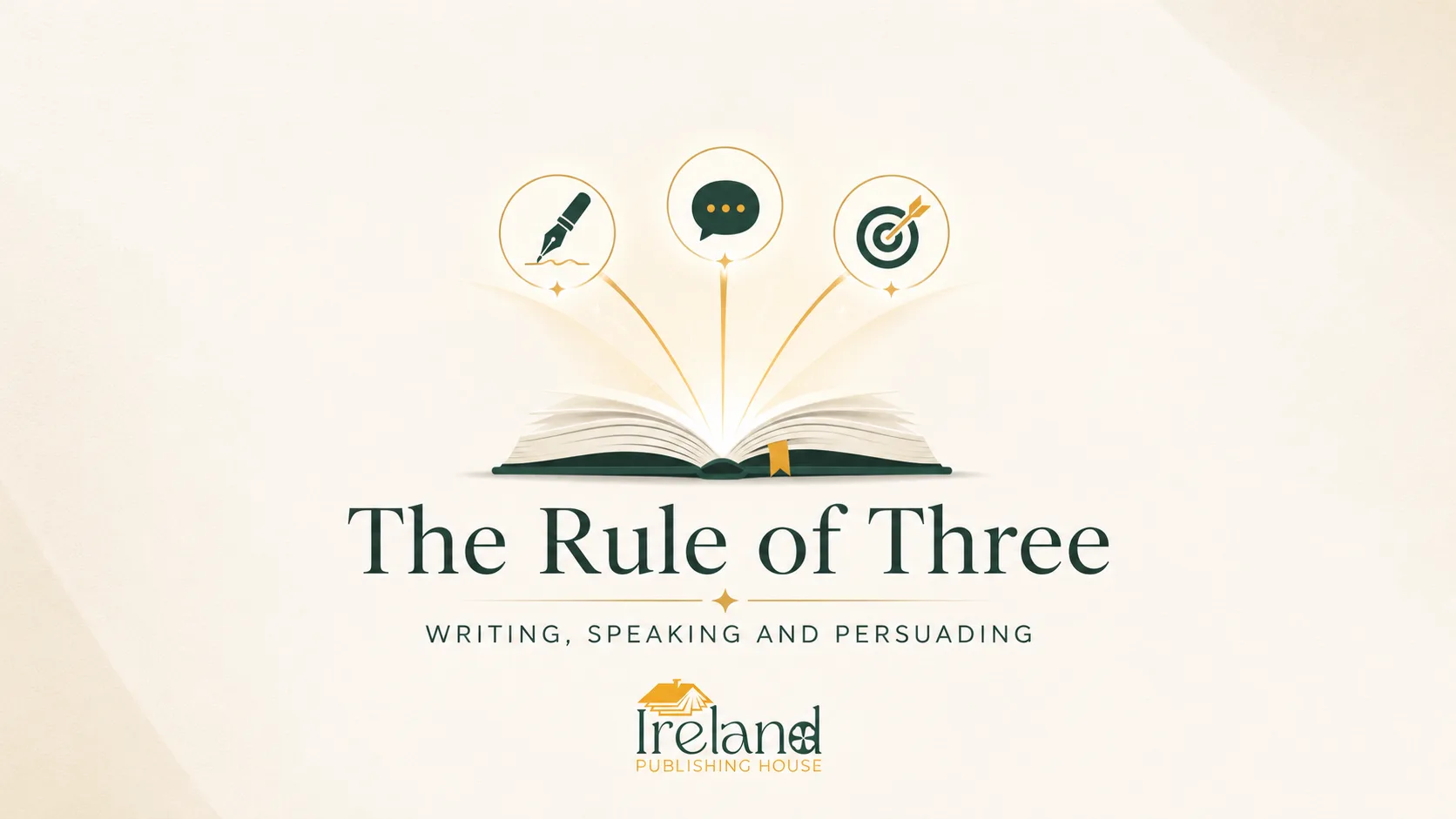
Why do some phrases echo in your mind for years, while others vanish the moment you scroll past? Think of the lines that have actually stuck with you. Chances are, most of them arrive in threes.
"Life, liberty, and the pursuit of happiness." "Blood, sweat, and tears." "Snap! Crackle! Pop!" You didn't memorise these on purpose. They memorised themselves, because something about the number three is quietly, relentlessly persuasive.
That something is the rule of three, and it's the hidden architecture behind the world's most persuasive writing and speaking. Speeches that moved nations, adverts that sold products for decades, opening lines that made readers stay up past midnight, nearly all of them lean on a group of three.
Here's what you'll get from this guide: a proper understanding of why three works on a psychological level, a plain method for building your own triads on demand, and a set of examples, exercises, and mistakes-to-avoid that turn the rule of three from something you've heard of into something you actually use. Let's get started, and let's rewire the way you write.
What Is the Rule of Three?
The rule of three is simple, powerful, and universal. It's a writing and communication principle built on one observation: information grouped in threes feels more satisfying, more memorable, and more persuasive than information grouped any other way. Three is the smallest number that creates a pattern. One item is a statement. Two is a comparison. Three is a rhythm, and rhythm is what sticks.
This isn't a modern marketing gimmick either. Aristotle was writing about the persuasive power of structured groupings in his Rhetoric more than two thousand years ago, and the pattern shows up again and again in cognitive science today, which we'll get into properly in a moment.
The Anatomy of a Triad: What Makes Three Work
Every effective triad has three jobs to do. The first item sets the stage. The second builds momentum. The third delivers the payoff. Take Julius Caesar's "I came, I saw, I conquered." The first phrase tells you where he is. The second tells you what he did there. The third lands the point: he won, decisively, and there's nothing left to add.
That structure, setup, build, payoff, is why triads aren't really lists at all. They're miniature narratives. A grocery list of three items ("milk, eggs, bread") doesn't move you the way "he came, he saw, he conquered" does, because the second version has a shape. It's telling a tiny story with a beginning, middle, and end.
Why This Guide Goes Further
Plenty of articles will tell you the rule of three exists. Fewer will show you why your brain is built to respond to it, or hand you a repeatable process for building triads that don't feel forced. This guide does both, and it draws on rhetoric that spans two thousand years, from Aristotle's assemblies to a TikTok caption written this morning.
Why Three? The Psychology and Neuroscience Behind the Magic
Your Brain on Triads: Pattern Recognition and Cognitive Ease
The human brain is a pattern-seeking machine, and three is the minimum number of data points needed to establish a pattern. One event is just an event. Two might be a coincidence. Three is when your brain sits up and says, this is a thing.
Kurt Carlson and Suzanne Shu's 2007 study on streak perception, published in Organizational Behavior and Human Decision Processes, found exactly this in a completely different context: gambling and basketball. Their data showed that our sense of a "streak" tops out right at the third repeat in a sequence, meaning we don't read much extra meaning into a fourth or fifth repeat once the third has already convinced us a pattern is real. The same wiring that makes a gambler see a "hot streak" after three wins in a row is the wiring that makes a triad in your writing feel inevitable rather than arbitrary.
Think of it like a rhythm. One beat is a noise. Two is a coincidence. Three is a groove.
The Ground State of Three: A New Cognitive Hypothesis
A 2026 preprint, currently circulating under the title "The Ground State of Three," proposes something intriguing: that the mind naturally compresses larger quantities down to three and expands smaller ones up to three when it needs to hold information in working memory. It's an early-stage hypothesis rather than settled science, but it offers a tidy explanation for why we chunk phone numbers into threes, remember "three key points" from a meeting, and feel a low hum of unease when we're handed exactly two options or exactly four.
Cognitive Load and Decision Paralysis: Why Three Is the Sweet Spot
Offering someone three choices, rather than five or six, measurably reduces cognitive load and speeds up decision-making. This is closely related to Hick's Law, which describes how decision time increases with the number and complexity of choices available. Barry Schwartz's work on the paradox of choice makes a similar point: too many options doesn't make people feel free, it makes them feel stuck. Three options feels like a considered shortlist. Six feels like homework.
If you want to see this in your own drafts, tools like Hemingway Editor are useful for spotting when a sentence has quietly grown a fourth or fifth clause that's diluting an otherwise clean triad.
It's worth putting this next to George Miller's famous 1956 paper on working memory, often shortened to "the magic number seven, plus or minus two." Miller's research suggested we can hold around seven unrelated items in short-term memory before we start dropping them. The rule of three sits underneath that ceiling rather than contradicting it. Seven is roughly the most you can hold. Three is the number you can hold effortlessly, without any sense of strain, which is exactly why three feels natural and seven feels like an actual list you'd need to write down.
The Neuroscience of Satisfaction: Dopamine and Closure
Completing a pattern triggers a small dopamine release, which is part of why a well-structured three-part argument feels satisfying in a way that's almost physical. When you hand your reader a triad, you're not just informing them, you're giving their brain a tiny hit of pleasure. Use that with care, and use it on the point you actually want them to remember.
A Journey Through Time: The Rule of Three from Aristotle to TikTok
Ancient Roots: Rhetoric's Greatest Hits
Aristotle built his entire theory of persuasion on three modes: ethos, pathos, and logos, character, emotion, and logic. Cicero leaned hard on the tricolon, a three-part sentence structure that Roman orators used to make arguments land with a rhetorical thud. Mark Forsyth's The Elements of Eloquence is a genuinely enjoyable modern guide to these classical figures of speech, if you want the deeper cut. The ancients didn't have fMRI machines, but they knew what stuck. They tested these techniques on live audiences for centuries, and the ones that didn't work simply didn't survive.
Folklore, Religion, and the Power of Three
Triads run through storytelling everywhere you look, and Ireland has one of the richest traditions of any culture on earth. Long before Aristotle's Rhetoric reached these shores, Irish scribes were compiling the Trecheng Breth Féni, better known as the Irish Triads, a medieval collection of wisdom and observation delivered almost entirely in groups of three: "three slender things that best support the world, the slender stream of milk into the pail, the slender blade of green corn upon the ground, and the slender thread over the hand of a skilled woman." That's not a rhetorical exercise dreamed up for a marketing brief. It's how an entire literary culture chose to organise its wisdom, centuries before anyone had a word for "copywriting." Three wishes, three little pigs, the three fates, the Holy Trinity, these patterns exist across cultures because a triad is simply the smallest shape a story can take and still feel complete.
If you're an Irish writer looking to lean into this tradition rather than just borrowing Aristotle's version of it, our piece on poetic techniques for Irish authors goes further into the rhythmic devices, native to this island, that pair naturally with the rule of three.
The Modern Echo: From Churchill to Clickbait
Trace that same shape forward and you land on Churchill's "never give in, never give in, never, never, never," on Martin Luther King's cascading anaphora, and on advertising slogans built to survive decades of repetition: "Snap! Crackle! Pop!" Now look at a viral TikTok script structured as setup, twist, payoff, and you're looking at the exact same architecture Cicero was using in the Roman senate. The medium changes. The pattern that makes it stick does not.
The Rule of Three in Action: Applications Across Every Medium
Creative Writing: Plot, Character, and Prose
The three-act structure and beyond. Setup, confrontation, resolution, the classic three-act structure is the rule of three operating at the scale of an entire book. Even a single blog post benefits from thinking in three acts: problem, exploration, solution. It gives your piece a spine instead of a shapeless middle. This matters most in your opening pages, since a reader decides whether to keep going within the first few paragraphs, and our guide to writing a strong first chapter of a novel leans on the same setup-build-payoff shape to hook a reader before they've even reached the second act.
Character arcs in threes. Character development tends to follow its own three-beat pattern, an initial state, a transformation, and a new equilibrium. If you're working on a novel and want a second pair of eyes on how your character's arc is landing, our fiction ghostwriting team spends a lot of time exactly here, making sure the shape of a character's journey actually pays off by the final page.
Sentence-level triads: tricolon and parallelism. Dickens and Hemingway both reached for the tricolon constantly, three clauses of roughly matching length and rhythm. The effect only works if the grammar is genuinely parallel, which is worth understanding properly if you want to build your own; our piece on figurative language covers tricolon alongside the other devices that make prose sing.
Speechwriting and Public Speaking: The Sound of Persuasion
The tricolon: your secret weapon. "Government of the people, by the people, for the people" is a tricolon doing exactly what it was built to do. In a speech, pause slightly after each item. The silence is part of the rhythm. It builds anticipation and makes the final item land like a hammer.
Structuring a speech with three main points. A reliable template: open with a hook, a thesis, and a preview of your three points, deliver the body as point one, two, three, then close with a summary and a call to action. The Six Minutes website has solid templates and video breakdowns if you want to study working examples.
Anaphora and epistrophe: amplifying triads. Repeating the beginning or end of each phrase in a triad multiplies its power. "We shall fight on the beaches, we shall fight on the landing grounds, we shall fight in the fields" is a triad and a repetition working together, the rhetorical equivalent of a crescendo. If you're preparing a speech and want it recorded properly once it's written, our audiobook services can help you get the rhythm you've built on the page to actually land the same way out loud.
Marketing and Advertising: Selling in Threes
Slogans, taglines, and value propositions. "Just Do It." "I'm Lovin' It." Three-word slogans and three-part value propositions dominate the advertising world for a reason. When you're crafting a value proposition, limit yourself to three benefits. Any more and you dilute the message; any fewer and it feels incomplete.
The rule of three in copywriting frameworks. PAS (Problem, Agitation, Solution) and AIDA (Attention, Interest, Desire, Action) are both triadic structures wearing different clothes. Grammarly's tone detector is a decent sanity check for keeping a three-part pitch consistent in voice from first line to last.
Social media and short-form content. "Three steps to better mornings: hydrate, move, meditate." That's the rule of three doing the heavy lifting in twelve words. In the age of AI-generated content, a genuinely well-built triad is your human edge, something that feels inevitable rather than templated, which an algorithm still struggles to fake convincingly. If you're building out the marketing plan around a book launch, our marketing team builds exactly this kind of short-form copy into launch campaigns.
Film and Video: Visual Triads
Screenplays are built on the same three-act structure as novels, and individual scenes often carry their own three-beat rhythm underneath. The rule of three shows up visually too, in the rule of thirds, the composition principle that splits a frame into three sections to create a balanced, engaging image. If you're putting together a book video trailer to launch your title, the same setup-build-payoff shape that works in a speech works just as well in thirty seconds of footage.
UX Writing and Microcopy: Three Little Words That Guide Users
Limiting navigation options, onboarding steps, or feature highlights to three genuinely improves usability. It's enough to feel empowered, not so many that you feel paralysed. "Search, discover, save" is a triad doing a UX job. "Oops! Something went wrong. Don't worry, we're on it. Try again in a moment," is a three-beat error message doing the same thing with reassurance instead of instruction. If your author site needs this kind of clear, structured copy across its pages, our author website service builds it in from the ground up rather than bolting it on afterward.
Business Communication: Emails, Reports, and Pitches
The three-part email that gets a response follows a simple template: context, request, benefit. "Following our call, I wanted to confirm the launch date, ask whether you can send the final cover file by Friday, and let you know this keeps us on track for the pre-order window." Three clauses, three jobs, no scrolling required. It's scannable and it's actionable, and busy people respond to both.
Presentations follow their own classic rule of three: tell them what you'll tell them, tell them, tell them what you told them. For complex arguments, try a nested rule of three, three main sections, each with three sub-points. Say you're pitching a book to a publisher. Section one might cover the market, with three sub-points on audience, comparable titles, and timing. Section two covers the manuscript itself, three sub-points on premise, voice, and structure. Section three covers you, three sub-points on platform, experience, and availability. Nine points total, but because they're grouped into three sets of three, the pitch feels considered rather than overwhelming. A small mechanical note while you're building pitches like this: keep the punctuation inside each triad consistent, commas for a flowing list, an em dash if you want a harder pause before the final beat. Our guide on em dashes and en dashes is worth a look if you're not entirely sure which one you're reaching for.
How to Master the Rule of Three
Step 1: Identify the core message. Before you write a word, decide on the single takeaway you want your audience to remember. This is the landing point everything else builds toward. Start with the end in mind, your three points should lead the audience toward that conclusion like arrows pointing at a target.
Step 2: Brainstorm in threes. Mind map or freewrite to generate ideas, then force yourself to group them into three buckets. If you've got more than three, combine or cut. When one of our writers was structuring a keynote for a tech conference, the client arrived with seven key points. Forcing them into three themes didn't just tighten the speech, it made each point more memorable, and the audience was still quoting those three themes weeks later.
Step 3: Structure for rhythm and parallelism. Once you've got your three points, shape them so they share a similar grammatical structure. That similarity is what creates the musical quality that makes triads stick. If your triad is built from descriptive words rather than actions, "confident, curious, and kind" rather than "search, discover, save", the same parallelism rule still applies, all three need to be the same part of speech and roughly the same weight. Our list of adjectives to describe a person is a genuinely useful reference here if you're building a character description or an author bio and want three words that actually sit together rather than clashing in tone. Read your triad aloud once you've drafted it. If it doesn't have a natural, almost musical cadence, rework the word choice or syllable count until it does.
Step 4: Place your triad strategically. Triads do the most work in headlines, opening lines, transitions, and closings. In headlines specifically, the rule of three often outperforms a longer list. "7 Days, 3 Habits, 1 Morning Routine" earns more clicks than "10 Tips for a Better Morning," because three feels considered where ten feels like scrolling.
Step 5: Test and refine. Read your triad to someone else. Ask them to recall the three points an hour later. Revise based on what actually stuck and what didn't. When a landing page was restructured around a three-part value proposition, conversions rose by 12%, and that kind of result is exactly why testing matters more than instinct alone.
Step 6: Know when to break the rule. Don't force it. If a point genuinely has four strong supporting arguments, use four. The rule of three is a guideline, not a straitjacket. Forced triads feel artificial and undermine the trust you've been building with your reader.
Learning from the Masters: Examples and Case Studies
A handful of triads have survived for decades, or centuries, because they do everything right:
"Life, liberty, and the pursuit of happiness"
"Veni, vidi, vici"
"Government of the people, by the people, for the people"
"Snap! Crackle! Pop!"
Worth noting: Churchill's most quoted phrase, "blood, toil, tears, and sweat," is actually a quad, four items, not three, though it's commonly misremembered as a triad. That misremembering is itself proof of how strongly we default to grouping things in threes, even when the source material doesn't cooperate.
Case Study: Deconstructing "I Have a Dream"
Martin Luther King's most famous speech operates on the rule of three at every level simultaneously. The overarching structure moves through the past, the present, and the future. Individual triads recur throughout, "one hundred years later," "now is the time," "we can never be satisfied." And the climactic anaphora, the repeated "I have a dream," builds through triads within triads. It's a masterclass in fractal structure. Map it out and you'll see the rule of three everywhere, at the sentence level, the paragraph level, and the level of the speech as a whole.
Case Study: "See It. Say It. Sorted."
Not every great triad comes from a president or a poet. The UK and Irish rail network's safety campaign, "See it. Say it. Sorted," is a masterclass in miniature. Three words, three imperatives, each one shorter than the last, building toward a full stop rather than a comma. It's been repeated so often on station platforms that it's become a genuine cultural in-joke, and that's arguably proof the triad is working exactly as intended. Compare it to the flatter, more literal alternative a committee might have produced instead, "If you notice anything suspicious, please report it to a member of staff", and the difference in stickiness is immediate. One triad beats one sentence of instructions almost every time.
The Comedy Rule of Three: Setup, Setup, Punchline
Comedians use the rule of three constantly. The first two items establish a pattern, and the third subverts it. "I love long walks on the beach, candlelit dinners, and tax evasion" works because your brain has already settled into the pattern by item two, which makes the swerve in item three land. This is the same mechanism behind dramatic irony, expectation set up, then broken, just aimed at getting a laugh instead of a gut-punch. Practise by writing setup-punchline triads daily. It's the fastest way to internalise the rhythm.
Pitfalls to Avoid: Common Mistakes and How to Fix Them
The forced triad. Writers sometimes shoehorn ideas into groups of three, creating awkward or redundant points. This makes the writing feel contrived, and readers can sense padding from a mile off. If you can't find three natural points, use two or four. A powerful pair can be just as memorable as a triad, think "life and death," "love and war." Don't sacrifice truth for symmetry.
Lack of parallelism. A triad loses its rhythm the moment its grammatical structure stops matching across all three items. "She likes reading, to swim, and hiking" clunks because the three verbs don't match in form. "She likes reading, swimming, and hiking" fixes it instantly. This is exactly the kind of thing a proofreader's eye catches on a full read-through that a writer, three drafts deep, has stopped noticing; our proofreading service exists precisely for this final pass.
Overuse. Using triads in every single sentence wears the effect out fast. Think of a triad like bold or italics. Bold every word and nothing stands out anymore. Save triads for the points that actually deserve the emphasis.
Clichéd triads. "Blood, sweat, and tears" has been used so often it's stopped landing. Invent fresh triads rather than reaching for tired ones, and if your manuscript is leaning on a few too many familiar phrases, a professional editing pass will usually catch the clichés you've stopped seeing yourself.
Ignoring audience and context. A triad built for a stage speech can fall completely flat in a two-line email. Adapt the rhythm and the length to the medium you're actually writing for, not the one you learned the technique in.
Practice Makes Powerful: Exercises and Prompts
Exercise 1: Triad spotting. Take a piece of writing you admire and mark every triad you find. For each one, ask whether it's genuinely earning its place or just filling space. This single habit trains your ear faster than almost anything else on this list.
Exercise 2: Rewrite a weak sentence. Take a flat, listless sentence, "The garden was nice and had flowers," and rewrite it using the rule of three. Start with the core idea, then ask what the three facets of it are, and how they can build to a climax: "The garden smelled of jasmine, buzzed with bees, and glowed gold in the evening light."
Exercise 3: Outline in three parts. Pick a topic, "why remote work is the future" works well, and build a three-point outline before you write a single sentence of the actual piece. If you're doing this for a full manuscript rather than a single post, our guide on how to write a synopsis walks through the same three-part thinking at a much larger scale.
Exercise 4: The daily triad drill. Write one original triad every day for a week, a headline, a value proposition, a joke, it doesn't matter which. By day seven, you'll start thinking in threes without trying.
A quick self-test: triad or not? Read each line below and decide whether it's a working triad, a forced one, or not a triad at all.
"Search, discover, save." (A genuine triad, three parallel verbs, each pulling the reader forward.)
"The dog was brown, it barked loudly, and it was Tuesday." (A forced triad, the third item has nothing to do with the first two.)
"Fast and reliable." (Not a triad at all, only two items.)
Your Rule of Three Toolkit
A short checklist for applying everything above:
Step | What to do |
1 | Define your single takeaway |
2 | Brainstorm and group ideas into three buckets |
3 | Craft parallel, rhythmic phrasing |
4 | Place triads strategically, headlines, openings, closings |
5 | Read aloud and test for recall |
6 | Check for forced or clichéd triads |
Recommended tools:
Hemingway Editor, for analysing sentence rhythm and clarity
Grammarly, for refining parallelism and tone
Milanote or Miro, for visually mapping three-part structures
The Elements of Eloquence by Mark Forsyth, for deeper rhetorical grounding
Six Minutes, for speechwriting templates and video breakdowns
AnswerThePublic or AlsoAsked, for spotting three-part question clusters from real search data
Further reading: Carlson, K.A. & Shu, S.B. (2007), "The Rule of Three: How the Third Event Signals the Emergence of a Streak," Organizational Behavior and Human Decision Processes, 104, 113-121. This article is fact-checked and periodically reviewed to keep examples and research current.
Bringing Your Triad-Powered Writing to Life
Once you've got the rhythm of the rule of three genuinely working in your writing, whether that's a novel, a memoir, a business pitch, or a children's story, the next question is usually what to do with it. That's where Ireland Publishing House comes in.
If the writing itself needs a hand, whether that's shaping a manuscript from scratch or polishing one you've already drafted, our ghostwriting team works directly with authors to get the structure, rhythm, and voice right from the first page. Once the words are in good shape, our formatting and design teams turn a well-structured manuscript into a properly laid-out book, print and digital both. A triad works just as well on a book cover as it does in a sentence, three words, three images, three colours, and our designers know how to make that land visually the way a tricolon lands on the ear.
Some stories lend themselves to illustration rather than just text, and folklore built on threes, three wishes, three little pigs, three brothers on a quest, is a natural fit for a younger reader. Our children's book publishing and book illustration services exist specifically for authors building that kind of story, where the rule of three isn't a rhetorical device so much as the entire architecture of the plot.
And once your manuscript is genuinely ready, whether you're printing physical copies for a launch through our book printing service or getting your title live on Kindle through our Amazon Kindle publishing support, or exploring our full publishing pathway from manuscript to market, we're set up to help you bring the whole thing home.
The Power of Three in Your Hands
We've gone from Aristotle's assemblies to Cicero's tricolons, through medieval Irish triads and Churchill's wartime speeches, all the way to a TikTok caption written this morning. The pattern hasn't changed in two thousand years, because it isn't a trend, it's a fundamental shape of human cognition.
Pick one piece of writing you're working on right now. Find the one place where a triad could turn a good point into a great one. Craft it, test it, and watch it stick.
The best way to master the rule of three is to teach it. Share this guide with a colleague, then talk through how you each applied it. Teaching cements the learning far faster than reading alone ever will.