You've written a line like "her smile was as bright as the sun" and felt absolutely nothing when you read it back. Or you've read a manuscript, a blog post, or a school essay stuffed with comparisons that all sound the same: brave as a lion, quiet as a mouse, busy as a bee. The words are there. The image isn't.
That's the trouble with a lot of advice on similes. Most guides give you a definition, throw fifty examples at you, and leave you exactly where you started: knowing what a simile is but not knowing how to write one that actually works. You close the tab with a list of quotes and no method for generating your own.
This piece is different. Yes, you'll get the definition, sorted properly this time, and the distinction between a simile, a metaphor and an analogy that so many writers mix up without realising it. You'll get the four real types of simile, examples from literature with proper attribution, and a full walk through why clichés fail the moment a reader spots them coming. But the real point of this guide is the method: a repeatable, step-by-step process for building original comparisons from scratch, plus a revision checklist you can run against your own draft this afternoon.
Why do cliched similes fail so badly? Because a reader's brain stops doing any work the instant it recognises a phrase it has met a thousand times before. "As brave as a lion" doesn't put a lion in anyone's head any more. It's a code that means "brave," nothing more, and the reader's eye slides straight past it. The image died the first hundred times the phrase got used, and every writer since has been paying the price. This isn't a talent problem. Nobody sat you down and taught you how to build a fresh comparison on demand, so you reached for the ones already sitting in your head, the ones everybody reaches for.
By the end of this guide you'll be able to open your own manuscript, spot a weak simile in seconds, and rewrite it into something that actually does its job. This guide and the definitions here are checked against standard English-language dictionaries and long-established literary sources, so you're working from something solid, not a half-remembered rule from school.
It's also worth saying this once, plainly, before we go any further: a simile is not decoration. It's a precision tool for making a reader see exactly what you mean, and most writers are using it with the safety on, reaching for the nearest familiar phrase instead of building something that fits the sentence in front of them. That's the habit this guide is here to break.
What Is a Simile? The Core Definition
A simile is a figure of speech that compares two dissimilar things using "like" or "as." That's the whole definition, and it's worth sitting with the word "dissimilar" for a second, because that's where most confusion starts. The two things being compared have to be genuinely different from one another. Comparing a dog to a puppy isn't a simile; it's just a description, because a puppy is a dog. A simile needs a gap for the reader's mind to jump across.
"The night was as dark as coal."
"He ran like the wind."
Both sentences hold two things that don't belong together on the surface: night and coal, a man and the wind. The comparison forces a small mental leap, and that leap is what creates the picture.
How a Simile Actually Works
Every simile has two working parts. The tenor is the thing being described. The vehicle is the thing it gets compared to. Take "her voice was like honey." The tenor is her voice. The vehicle is honey. The reader has to bridge the gap between a sound and a substance, and that bridging is where the meaning lands, not in either word on its own.
The power of a good simile comes from a connection that's unexpected but accurate. If the connection is obvious, the reader feels nothing. If it's inaccurate, the reader feels confused. The sweet spot is a comparison that surprises for a second and then feels completely right.
Here's the single most useful thing you'll read in this guide: anchor every simile in the character's or narrator's world, their knowledge, their quirks. A farmer's narrator reaches for weather and soil. A mechanic's narrator reaches for engines and rust. A nurse's narrator reaches for the ward at 3 am. That one habit will do more for your similes than any list of examples ever could, and we'll come back to it properly later in this guide.
Simile Versus a Plain Literal Comparison
Not every sentence with "like" or "as" is a simile. "She looks like her sister" is a literal comparison, not a simile, because the two things being compared, one sister's face and another sister's face, are genuinely similar. There's no figurative leap, just an observation.
Literal comparison: "This coffee tastes like the coffee we had yesterday." Similar things, compared directly.
Simile: "This coffee tastes like regret." Dissimilar things, compared figuratively.
Keep that distinction in your back pocket. It'll save you from second-guessing whether a sentence in your own draft counts as a simile or is simply describing something accurately.
Where the Word Comes From
"Simile" traces back to the Latin similis, meaning "like" or "similar." It's a device with serious age on it. You'll find similes running through Homer's epics, through the Bible, through Old Irish and Old English verse, long before anyone wrote a style guide about them. This isn't a modern invention dressed up as an old one. Writers have been reaching for this exact tool for as long as anyone has been writing anything down.
Simile Versus Metaphor Versus Analogy
Here's the pain point that trips up more writers than almost anything else in this guide: using "simile," "metaphor," and "analogy" interchangeably, without ever choosing between them on purpose. All three are comparison devices. All three work differently, and picking the right one is what separates deliberate, controlled prose from writing that just happens to land somewhere near the right effect.
Simile compares two unlike things using "like" or "as." The comparison is stated out loud, so the reader notices it happening.
Metaphor states that one thing is another thing, no "like," no "as." The comparison is folded into the sentence itself rather than announced.
Analogy is an extended comparison that explains something complex or unfamiliar by relating it to something simpler, usually across several points rather than one.
Device | Definition | Example | When to Use |
Simile | A figure of speech comparing two dissimilar things using "like" or "as" | "Her eyes were like two dark pools." | When you want the reader to notice the comparison happening, or when the two things are only partly alike, and you want to isolate one specific quality |
Metaphor | A figure of speech that directly identifies one thing as another, without "like" or "as" | "Her eyes were two dark pools." | When you want a more forceful, immediate identification, collapsing the distance between the two things entirely |
Analogy | An extended comparison explaining an unfamiliar idea through something familiar, often across multiple points | "A simile is a bridge. It connects two separate things and lets the reader walk from one to the other, seeing both clearly." | When you're explaining a complex idea or process and a single line of comparison won't carry the whole weight |
Worth noting: analogies often contain similes or metaphors inside them, since an analogy is a broader explanatory structure rather than one single figure of speech. The bridge analogy above is itself built on a simile.
When to Reach for Each One
Choose a simile when the act of comparing is meaningful in itself, when you want to highlight one particular quality without claiming total identity between the two things. Choose a metaphor when you want the identification to feel immediate and complete, when "like" or "as" would actually weaken the effect by putting distance between the two things. Choose an analogy when you're explaining something genuinely complex and a single comparison can't carry it, when the parallel needs to be sustained across a few sentences or a full paragraph. Our guide on metaphor examples goes deeper into the second option if that's the device you end up needing more often.
The "Similes Are Weaker" Myth
There's a persistent idea floating around that similes are somehow the lesser device, the one you use when you can't commit to a proper metaphor. That's wrong, and it's worth debunking properly. Similes aren't weaker. They're different, and that difference is a tool, not a limitation.
A simile's explicit "like" or "as" does something a metaphor can't: it invites the reader to hold two things side by side and actually notice the comparison happening. That awareness can be more honest, and often more precise, than a metaphor's flat identification. When the comparison is only partial, when you want the reader conscious of the gap between the two things rather than pretending it isn't there, a simile is the stronger choice, full stop. A war reporter writing "the city looked like a body after an autopsy" gains something a metaphor version would lose: the reader stays aware that the city is not literally a body, and that distance is doing real work in the sentence.
Types of Similes: Simple, Extended, Epic and Implied
Most writers know a simile when they see one, but far fewer can name the four distinct types, and knowing them changes how deliberately you can use each one.
Simple Similes
The simple simile is a single, brief comparison that makes one point and moves on. It's the workhorse of everyday prose, the type you'll use most often by a wide margin.
"The fog came in like a slow grey wave."
Best used for quick sensory impressions, single-point comparisons, and keeping a scene moving without slowing the reader down.
Extended Similes
An extended simile develops the comparison across several phrases, sentences, or even a full paragraph, working through multiple points of correspondence rather than just one. It gives you room for nuance, but it costs space, so save it for moments that actually deserve the emphasis.
Simple version: "His mind was like a cluttered desk."
Extended version: "His mind was like a cluttered desk, papers stacked in precarious towers, a coffee mug leaving rings on important documents, a pen rolled behind the monitor where no one ever reaches. Every thought was buried under something else, and nothing was ever where he looked for it first."
Reserve extended similes for the moments that deserve emphasis. If every paragraph has one, none of them land, and the reader starts skimming past them exactly the way they skim past clichés.
Epic (Homeric) Similes
The epic or Homeric simile is a long, elaborate comparison stretched over many lines, often stepping away from the main narrative entirely to develop the comparison in full. The type gets its name from Homer, whose Iliad and Odyssey are full of them: warriors compared to lions tearing through a flock of sheep, the comparison built out over several lines before the narrative returns to the battlefield.
You won't reach for this type often in modern prose. It's rare outside literary fiction, fantasy and poetry, but it's worth recognising, especially if you're writing in an elevated register or studying literature seriously, because a moment that calls for genuine grandeur can still use the full Homeric treatment to earn its weight.
Implied Similes
The implied simile is the subtlest of the four. It suggests "like" or "as" without ever stating the word, so the comparison is present, but the connecting word has been dropped entirely. This is the type experienced writers reach for when they want the comparison to feel woven into the sentence rather than announced.
"She had a tiger's patience." (Implying her patience was like a tiger's, without the word "like" ever appearing.)
Best used for subtle characterisation and advanced prose, and for breaking up the rhythm when you've already used "like" or "as" a few too many times on the page.
Choosing the Right Type for the Moment
A quick reference: simple similes for everyday prose and quick impressions, extended similes for emotional weight and introspection, epic similes for genuinely elevated or grand moments, and implied similes for subtle characterisation where you want the comparison felt rather than pointed at.
Similes in Literature: Real Examples, Properly Attributed
Reading how skilled writers use similes tells you more than any rule ever will. Here's a small, deliberately varied set, different eras, different genres, different effects, each attributed properly.
Charles Dickens opens A Christmas Carol with one of the most quietly comic similes in English fiction: Old Marley is described as dead as a door nail. The comparison is unexpected precisely because it's so mundane, a household object standing in for absolute finality, and the slight flatness of the image is part of the joke.
F. Scott Fitzgerald, describing the guests drifting through Gatsby's parties, wrote of them moving like moths among the whisperings and the champagne and the stars. That image does two things at once: it captures the guests' attraction to the glamour on display and their fragility, the way moths are drawn helplessly toward something that can just as easily destroy them.
W. B. Yeats, in "Long-Legged Fly," reaches for one of the strangest and most memorable images in his late work, comparing a mind moving in deep concentration to a long-legged fly upon the stream. The comparison works because it's so precisely physical: a fly balanced on the surface tension of water, barely touching it, moving without disturbing anything beneath.
These three examples share a quality worth naming directly. Each one is concrete and sensory rather than abstract. Each compares things that are genuinely dissimilar, a man and a nail, people and moths, a mind and an insect. And each one serves the tone of the piece it lives in: comic understatement for Dickens, glamour shading into unease for Fitzgerald, quiet strangeness for Yeats.
Similes Beyond the Classics
Similes aren't a museum piece. They're a living tool, and you'll find them doing serious work in contemporary fiction, memoir, and even sharp journalism. A memoirist describing grief might compare it to a weather system that never fully passes, something that returns without warning long after the funeral is over. A sports journalist covering a late collapse might compare a team's form to a tyre losing air overnight, fine at midnight, flat by morning. A fantasy writer building an unfamiliar world often leans on similes specifically because a simile lets the reader hold their own world and the invented one side by side, rather than demanding they accept a metaphor's flatter claim of total identity. If you're working in that territory, our piece on high fantasy covers more of what makes invented worlds feel lived in rather than borrowed.
Whatever genre you're writing in, the underlying discipline is the same: specific over general, sensory over abstract, and built from a world the reader can actually picture. Irish writing has always leaned heavily on this kind of grounded imagery, comparisons pulled from bog and weather and sea rather than borrowed abstractions, and that instinct is worth holding onto even if your setting is nowhere near Ireland at all. A comparison rooted in a real, specific place will almost always beat one pulled from nowhere in particular.
How to Write Original Similes: A Developmental Method
Here's the method this whole guide has been building toward. Before you write a single simile, ask one question: whose voice is narrating this sentence? A simile that could have been written by literally anyone is a wasted opportunity, because the comparison is one of the few places in a sentence where voice gets to show up directly. This character-voice-first approach solves two problems at the same time. It generates original comparisons, because every character's frame of reference is different, and it deepens voice, because the comparison itself reveals who's speaking.
The Six Steps
Identify exactly what you're describing. Write down the precise thing, feeling or action, and be specific. "Her anger" is too vague to work with. "The way her jaw tightened when she heard the news" gives you something to actually compare.
Ask what it looks, sounds, feels, smells or tastes like, before reaching for a comparison. Force yourself to observe first. Don't jump to the figurative leap yet; just describe the thing plainly, in sensory terms.
Brainstorm from the character's or narrator's world. List what this character knows intimately: their job, their hobbies, their childhood, their region, their obsessions. A chef's vocabulary is not a mechanic's vocabulary, and neither is a farmer's.
Find the unexpected connection. Look for a link between your sensory observation and something from the character's world that isn't obvious but is accurate. The best similes surprise the reader for a second and then feel inevitable.
Test the comparison. Is it concrete? Is it sensory? Is it specific? Does it deepen the character's voice? Does it match the scene's tone? If the answer to any of these is no, go back to step three and try again.
Write it, then read it aloud. Does it land naturally inside the sentence? Does it have rhythm, or does it snag? A simile that reads fine silently sometimes trips over itself the moment you say it out loud.
Revise weak similes by asking what the thing actually looks, sounds, feels, smells or tastes like, then build outward from that one specific detail. It's the single most effective move for rescuing a clichéd comparison, and it works almost every time.
Making Comparisons Concrete
Abstract comparisons don't create pictures. "As beautiful as a dream" tells the reader nothing, because dreams don't have a fixed image attached to them. Concrete comparisons do the opposite.
Abstract: "He was as strong as an ox." What does that actually look like? Nobody knows, because nobody has stood next to an ox recently.
Sensory: "He was as strong as a dockworker who'd spent thirty years hauling crates, his forearms thick as hawsers." Specific, visual, grounded in an actual world.
Abstract: "The silence was heavy." Heavy in what way? Nothing here gives the reader a picture to hold.
Sensory: "The silence sat over the kitchen like the air before a storm breaks, thick enough that you could feel it on the back of your neck." The reader now has weather, pressure, skin, something to actually stand inside.
Notice that neither sensory version is short. That's fine. A concrete comparison sometimes needs the extra words to earn its keep, and a single vague adjective almost never does the job on its own.
The "Have I Heard This Before?" Test
Here's the simplest cliché detector there is: if you've heard the comparison before, cut it. "As brave as a lion," "as quiet as a mouse," "as busy as a bee," "as cold as ice," all of them carry zero power, because a reader's eye has passed over each one a thousand times before yours. The test is a single question: does this comparison feel familiar? If the answer is yes, it's a cliché, and the goal isn't to avoid all comparison; it's to avoid comparisons that don't buy you anything.
When you're hunting for a fresher word to build from, a good thesaurus earns its keep here. Instead of settling for "quiet," look up the word and see what else is sitting nearby: hushed, muffled, stilled. Any one of those gives you a different, more specific starting point than the word everyone reaches for first.
Common Mistakes and Clichés to Avoid
The Cliché Hall of Shame
A quick reference list, sorted by category, of the comparisons that have worn out their welcome entirely.
Animal clichés: as brave as a lion, as busy as a bee, as quiet as a mouse, as sly as a fox, as stubborn as a mule
Weather clichés: as cold as ice, as white as snow, as clear as day, as quick as lightning
Object clichés: as hard as a rock, as light as a feather, as sharp as a tack, as smooth as silk
Emotion clichés: as happy as a clam, as sad as a rainy day, as angry as a hornet
Every single one of these has stopped doing its job. The words are recognisable. The image is dead.
The Echo Effect
The echo effect happens when a simile repeats an idea that's already sitting in the same sentence, adding nothing new. "The fire was as hot as a blazing furnace" is a good example: "hot" and "blazing" say the same thing twice, and "furnace" is already implied by "fire." The simile arrives and adds precisely nothing. Check for this by asking a simple question of every comparison you write: does this add new information, or is it just restating what's already there?
Other mistakes worth watching for:
Mixed comparisons, where two incompatible images get jammed into one sentence, a storm that spreads like wildfire, for instance, mixing weather and combustion in a way that doesn't hold together.
Overloading, stacking too many similes into one passage until the prose turns clunky and overwrought.
Forced comparisons, where the two things being compared aren't actually similar in any meaningful way, so the comparison doesn't earn its place.
Tone mismatch: a comparison that clashes with the scene's emotion or genre, a playful simile dropped into a funeral scene, for example.
The Cliche-to-Fresh Transformation Table
Here's what fixing a cliché actually looks like in practice: cliché on the left, a rewritten version on the right.
Cliche | Fresh Rewrite | Why It Works |
As brave as a lion | As brave as a first-year teacher walking into a classroom of thirty teenagers on the first day of school | Specific and grounded in a real scenario; the bravery is earned, not borrowed from a generic animal image |
As quiet as a mouse | As quiet as a house after the power goes out, no hum, no fan, just the tick of the cooling oven | Sensory and specific; creates a real auditory image instead of a vague animal comparison |
As busy as a bee | As busy as a short-order cook during Sunday brunch, flipping eggs with one hand and pouring coffee with the other | Concrete and visual; the busyness is shown, not just stated |
As cold as ice | As cold as the metal doorknob on a January morning, the kind of cold that bites before you even turn it | Sensory and tactile; the reader feels the cold, and the comparison is specific rather than generic |
As white as snow | As white as a fresh bandage against the skin | Unexpected and slightly unsettling; the comparison creates a specific visual and emotional effect |
Test any rewrite you produce yourself with the same question you'd ask of the original cliché: have I heard this before? If the answer is still no, and it's concrete and sensory, you've done the job properly.
Revision and Self-Editing: The Simile Checklist
The Self-Editing Flow
Run this three-step flow against every simile in a draft.
Spot. Read through and highlight every "like" or "as" comparison in the piece.
Diagnose. For each one, ask: Is it a cliché? Does it echo something already in the sentence? Are the two things genuinely dissimilar? Does it match the character's voice and the scene's tone?
Fix. If any answer is a problem, rewrite the simile using the step-by-step method above. If it can't be fixed, cut it entirely. A missing simile is never worse than a bad one.
The Checklist
Is this comparison a cliché? If you've heard it before, cut it or rewrite it.
Does it compare two genuinely dissimilar things?
Is it concrete and sensory rather than abstract?
Does it reflect the character's or narrator's voice and world?
Does it match the scene's tone and emotion?
Does it add new information, or does it just echo what's already there?
Does it land naturally when you read the sentence aloud?
Is it necessary, or is it decoration slowing the prose down?
Have you balanced figurative language with plain, literal description nearby?
If it's an extended or epic simile, does this specific moment earn that much space?
Let similes land only where they matter, rather than forcing one into every sentence. A paragraph with no similes at all is perfectly fine. A paragraph with three of them usually isn't.
Before and After
Before: "The room was as quiet as a mouse."
Diagnosis: cliché, vague, no sensory image.
After: "The room was as quiet as a held breath; even the clock seemed afraid to tick."
Before: "He was as fast as lightning."
Diagnosis: cliché, abstract, no specific image.
After: "He was as fast as a rumour through a small town, gone before the first door opened."
Practice Exercises
Warm-Up Prompts
Quick, low-pressure exercises designed to get you generating comparisons fast. Aim for volume here, not perfection.
Describe the feeling of waiting for important news using a simile grounded in a specific profession, a chef, a pilot, a gardener.
Write three similes for the same thing, a crowded train carriage, each from a different character's point of view: a tourist, a regular commuter, a child.
Take a cliché from the Hall of Shame above and rewrite it using the step-by-step method. Do this for three different clichés before you stop.
Character-Voice Exercises
Choose a character you're currently writing, or invent one on the spot. List ten things they know intimately: job, hobbies, childhood, region, obsessions. Then write five similes for common emotions, anger, joy, fear, boredom, love, using only comparisons drawn from that list.
Write the same short scene twice, once from a chef's point of view, once from a mechanic's. Use similes that reflect each character's world and notice how much the comparisons alone change the reader's sense of who's speaking.
Revision Drills
Take a page of your own writing, or a piece you admire. Highlight every simile. Run each one through the self-editing checklist above and rewrite whatever fails.
Find a piece of published writing full of clichéd similes; plenty of first drafts and blog posts qualify. Rewrite the clichés using the step-by-step method and compare your version against the original. What actually changed?
A notes app or a simple digital notebook is worth keeping open while you do this. Save every simile you admire from your own reading, note where it came from, and write one sentence on why it works. Over months, that becomes a genuine personal reference, not just a list.
Getting Your Writing Ready to Publish in Ireland
A sharp simile is worth nothing if the book or manuscript carrying it never reaches a reader properly. If you're working toward publication, the craft work covered in this guide is really only the first stage.
A professional edit is where clichés like the ones above tend to get caught if a writer missed them, alongside the bigger structural questions a simile alone can't fix. Our editing service works through a manuscript line by line with exactly this kind of language in mind. If you're building a book from scratch rather than polishing a finished draft, our ghostwriting service can shape a manuscript around your voice and story from the ground up, and a character-voice-first approach to comparison, the same method covered earlier in this guide, is exactly the kind of detail a good ghostwriter builds in from page one.
Once a manuscript is finished, proofreading catches the small slips a full edit can miss: the doubled word, the stray comma splice, the cliché that crept back in during a late revision pass. From there, formatting turns a clean manuscript into something that actually looks like a book on the page, whether that page ends up in print or on a screen.
The visual side matters just as much as the text. A striking cover design is often the first comparison a reader ever makes about your book, before they've read a single sentence, and for certain genres, fantasy especially, illustration work can carry the same kind of vivid, sensory imagery this guide has been asking you to build into your prose. A well-made book trailer does something similar for readers browsing online, giving them a fast, concrete impression of tone before they commit to a purchase.
Format decisions matter here too. Our piece on hardback versus paperback is worth a read if you haven't settled on a print format yet, and our printing service handles the physical run once that decision is made. If you'd rather reach readers digitally first, our guide on publishing on Amazon KDP walks through the practical side, and our dedicated Kindle publishing service can handle the setup directly if you'd rather hand that part off.
Some books work better heard than read, particularly ones built around strong, voice-driven imagery, and an audiobook can carry a well-built simile with a narrator's rhythm doing extra work the page can't. Writing for younger readers brings its own rules around figurative language entirely, simpler vehicles, gentler comparisons, and our children's book publishing team can guide you through what actually lands for that audience. And once the book itself is ready, an author website gives readers somewhere to find you afterwards, rather than losing them the moment they close the last page.
None of this replaces the sentence-level work covered earlier in this guide. But a fresh simile deserves a finished book around it, and that's the part Ireland Publishing House exists to help with, from the first draft through to a reader holding the finished copy.
Similes Inside the Wider Craft of Fiction
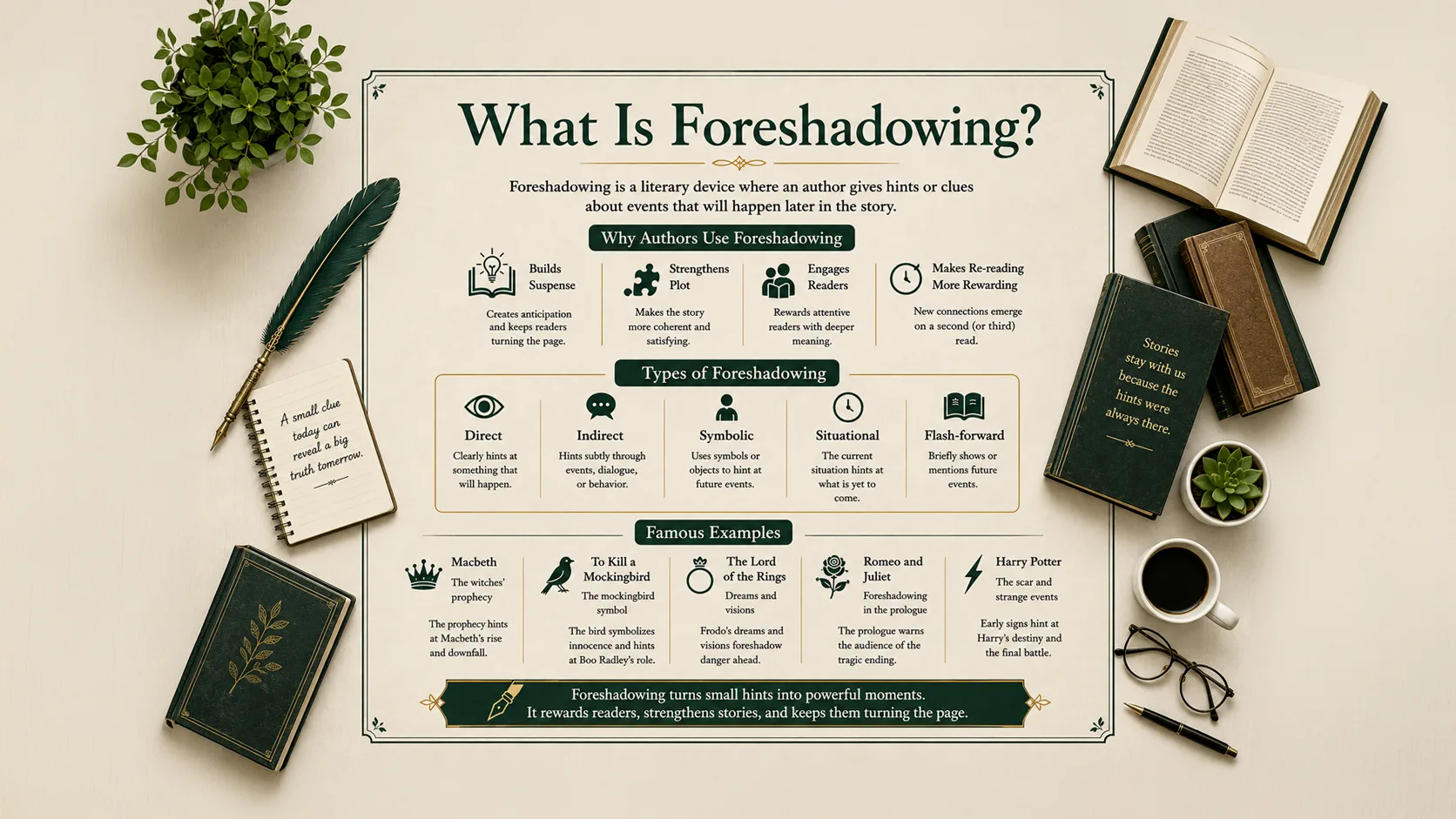
A simile rarely works in isolation. It sits inside a scene alongside plenty of other devices doing their own jobs, and understanding how they interact will sharpen your instinct for when a comparison is actually the right tool. A well-placed simile can carry pathos in a way a flatter sentence can't, giving a reader something concrete to feel rather than simply telling them how to feel. It can also do quiet work as foreshadowing, planting an image early that pays off later once the reader realises what the comparison was actually pointing toward.
Character work benefits too. The comparisons a protagonist and antagonist reach for say almost as much about them as their actions do, and giving each character a distinct bank of comparisons is one of the fastest ways to keep their voices from blurring together on the page. If you're building a fantasy world with its own internal logic, similes are often the safest way to introduce mythical creatures to a reader without a wall of explanation, letting a strange thing get anchored to something familiar in a single line. And whatever type of novel you're writing, from literary fiction to genre fantasy, the discipline behind a good simile stays exactly the same: concrete, sensory, and built from a world your reader can actually picture.
Final Thoughts
A simile compares two dissimilar things using "like" or "as." It's a distinct device from a metaphor and from an analogy, and knowing the difference lets you choose deliberately rather than by accident. There are four real types, simple, extended, epic and implied, each suited to a different moment in a piece of writing. The strongest similes are concrete, sensory, and grounded in a specific character's or narrator's world, and weak ones can almost always be fixed with the step-by-step method and the self-editing checklist covered above.
Here's your call to action, and it's a small one: pick one cliché out of your own writing right now, run it through the method, and rewrite it today. The skill builds with repetition, not with reading about it, and the exercises in this guide are here to get you started immediately.
This guide was reviewed and updated for 2026, and the definitions throughout have been checked against standard English dictionaries and established literary sources. It was written by the editorial team at Ireland Publishing House, who work with fiction and non-fiction writers across Ireland on everything from a first clumsy draft to a finished, printed book.