You know the moment. You're forty pages from the end of a novel, something clicks, and you flip back to a throwaway line from chapter two that you barely registered the first time round. It wasn't throwaway at all. The writer put it there on purpose, and you missed it, and now you can't stop thinking about how neatly it all fits.
That's foreshadowing doing its job. It's one of the most-used tools in fiction and one of the most misunderstood, because most readers can feel it working without being able to name it, define it, or tell it apart from the half-dozen literary devices that sit right beside it on the shelf. If you're writing your own novel, that gap matters. You can't analyse a technique you can't identify, and you can't deploy one you can't describe.
This guide sorts it out properly. We'll define foreshadowing and its pronunciation, set it against symbol, motif, red herring, and flash-forward so you're never fudging the difference in an essay again, walk through the main types with recognisable examples, and give you a repeatable method for spotting hints on a first read. There's a full section on writing about foreshadowing academically, with sentence frames and a worked paragraph, a worked setup-and-payoff trace through a single canonical text, and a practical planning guide for planting foreshadowing in your own fiction. By the end, you'll have a genuine toolkit, not just a definition you half-remember for the exam.
Whether you're drafting your first novel, polishing a second pass, or trying to work out exactly how much of a plot twist to give away, the same underlying skill applies: learning to write a story with an eye for what's being planted, quietly, ahead of time.
What Is Foreshadowing? (Definition and Pronunciation)
Foreshadowing is pronounced fore-SHAD-oh-wing, and it means exactly what the word looks like it means: a shadow cast forward, ahead of the thing that will eventually stand in the light.
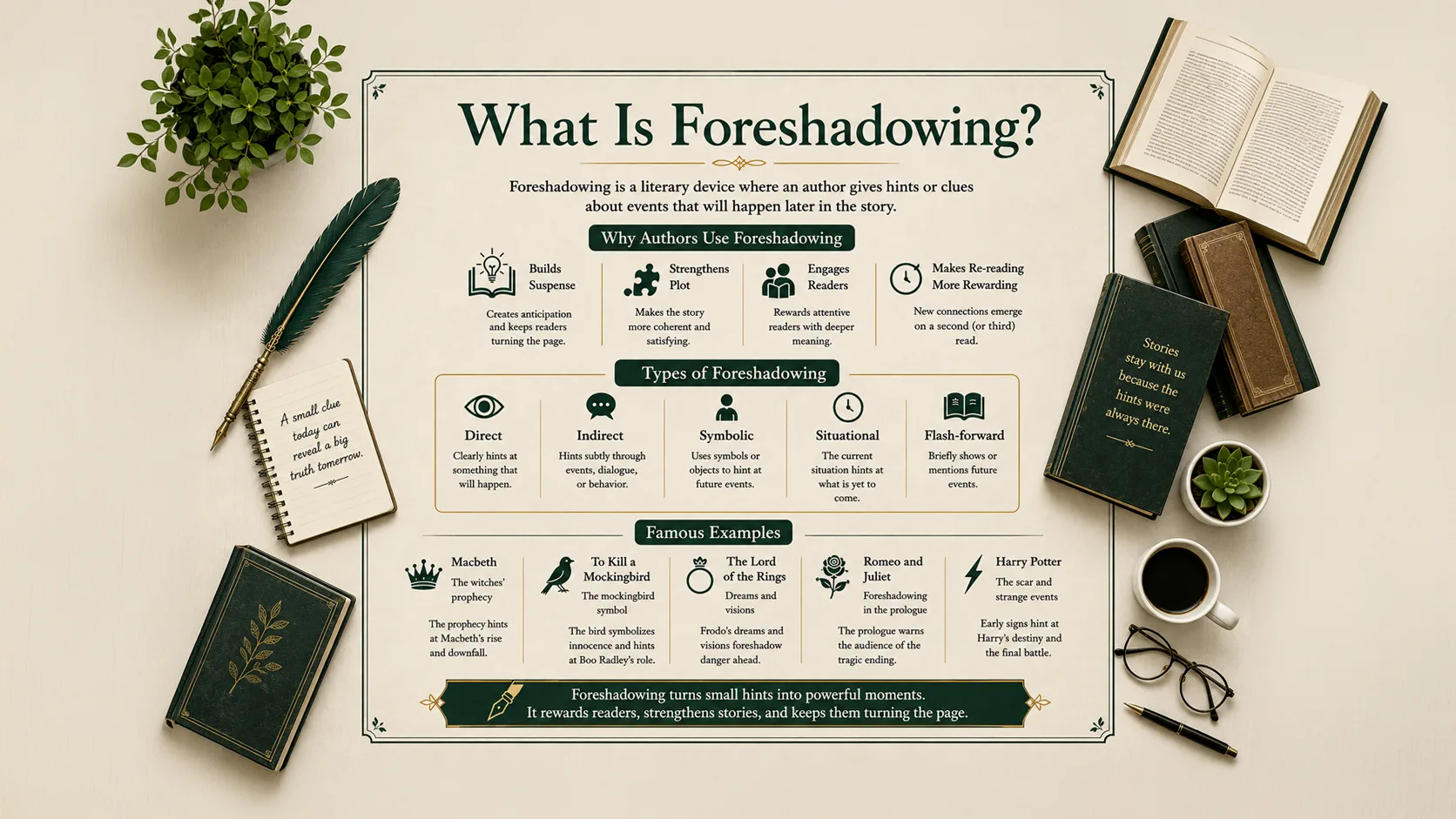
As a literary device, foreshadowing is a hint, clue, or suggestion planted earlier in a narrative that points towards an event, revelation, or outcome that hasn't happened yet. It works because narrative is sequential. We read one word after another, one scene after another, and a skilled writer uses that sequence against us: dropping a detail before we have the context to understand its weight, then paying it off later so the earlier moment retroactively gains meaning.
The key distinction, and the one students most often lose marks over, is that foreshadowing hints. It doesn't state. A narrator who says outright, "this decision would ruin him within the year," isn't foreshadowing so much as flatly telling you what's coming, which is a related but different move (more on that distinction below). True foreshadowing trusts the reader to hold a small, unresolved detail and carry it forward without being told what it means.
Foreshadowing appears in prose fiction, drama, poetry, screenwriting and even everyday storytelling. It's genuinely one of the oldest tricks in narrative craft, and it's just as alive in a contemporary Irish novel as it is in a Greek tragedy, where the chorus routinely tells the audience that ruin is coming long before the characters themselves see it.
It's worth saying plainly why the device works at all, because that's the part most definitions skip. Reading is linear, but understanding isn't. We take in a story in order, sentence by sentence, yet we're constantly building a mental model of where it's headed, testing our guesses against what actually happens. Foreshadowing exploits that gap directly. A writer drops a detail before the reader has enough information to weigh it properly, then lets the story's later events retroactively activate it. The first time round, it's noise. The second time, or the moment the payoff lands, it's suddenly signal. That flip, from background detail to load-bearing clue, is the entire mechanism, and it's why foreshadowing tends to reward rereading more than almost any other device on this list.
Foreshadowing vs Symbol vs Motif vs Red Herring vs Flash-Forward
This is where most explanations get muddy, because these five devices genuinely overlap in places. They're all forms of meaning that a writer plants for a reader to find, but they operate on different timelines and serve different purposes. Here's the side-by-side version, so you can stop guessing and start checking.
Device | What It Does | Quick Example |
Foreshadowing | Hints at a specific future event within the story's own timeline | The witches' prophecy in Macbeth |
Symbol | A concrete thing standing in for an abstract idea; can appear just once | A single broken window suggesting a fractured home |
Motif | A recurring element that builds meaning across the whole work | The green light recurring throughout The Great Gatsby |
Red herring | A deliberately misleading clue designed to throw the reader off | A suspicious-seeming character who turns out to be innocent |
Flash-forward | Actually shows a future scene, breaking chronological order to do it | A prologue that plays out a death, then jumps back to "how we got here" |
A few things that trip people up in essays. Foreshadowing and flash-forward are the pair writers confuse most, and the test is simple: does the text show you the future scene, or only hint that one's coming? A flash-forward is chronological time-travel; foreshadowing stays in the present moment and drops a clue.
Foreshadowing and symbol overlap because a symbolic object can also foreshadow, but the two aren't the same job. A symbol carries thematic weight and doesn't need to resolve into a plot event. Foreshadowing specifically points at something that will happen. If you want a fuller grounding in how symbolic language works before you tackle the trickier cases, our piece on metaphor examples in Irish life and literature is a useful companion read.
Motif is the recurring cousin: where foreshadowing plants typically once and pays off once, a motif shows up again and again, accumulating meaning rather than pointing at a single future beat. And a red herring is foreshadowing's evil twin: it uses the exact same technique, planting a detail early for the reader to notice, but the "payoff" is deliberately false. That's precisely why crime and mystery fiction lean on it so heavily. A well-timed foreshadowed reveal also tends to create dramatic irony along the way, so if that distinction is fuzzy too, our breakdown of the different types of irony is worth reading alongside this one.
Types of Foreshadowing
Not all foreshadowing looks the same on the page. Once you know the categories, you'll start spotting them everywhere.
Direct Foreshadowing
Direct foreshadowing is explicit. The text tells you, in more or less plain language, that something is coming, even if it withholds the details. The witches' prophecies in Macbeth are the textbook case: "none of woman born shall harm Macbeth" is a direct, stated warning, and the play spends its final act working out the loophole. The Prologue to Romeo and Juliet does the same thing before a single scene has played out, telling you flatly that these are "star-cross'd lovers" who won't survive. You're not meant to miss it. The tension comes from watching the characters walk towards a fate you've already been told about.
Indirect or Subtle Foreshadowing
This is the type most readers associate with the "aha" moment on a second read. Indirect foreshadowing hides in details so ordinary they don't register as significant the first time round: a piece of dialogue, an object mentioned in passing, a small habit. Obi-Wan's careful phrasing to Anakin about the future in Star Wars reads as simple mentorship advice until you know what's coming. The peppermints that recur through A Series of Unfortunate Events seem like a quirky running joke until their real relevance surfaces much later in the series. Subtle foreshadowing is the type that rewards rereading, because the clue was always there; you just didn't have the context to weigh it properly.
Partial or Mysterious Foreshadowing
Partial foreshadowing sits between the two. It signals unmistakably that something matters, without telling you what. A narrator opens with a line that implies dread or significance but withholds the specifics, so you read the whole book carrying a low hum of "something's coming" without knowing its shape. The opening of Before I Fall works exactly this way, framing the entire narrative around a hint the reader has to sit with until the story catches up to it.
Red Herrings
Strictly speaking, a red herring is the opposite of foreshadowing: it uses the same planting technique, but the payoff is false by design. It's the mainstay of crime and mystery fiction, where writers need multiple viable suspects and false leads to keep readers guessing until the reveal. A red herring works when it's genuinely plausible in the moment, not obviously fake, and it fails the reader if it turns out to have no internal logic at all once the truth comes out. If you want to explore how genre conventions shape reader expectation more broadly, our guide to the different types of novel and how their structures vary covers the ground well.
A Note on Scale
One more distinction worth holding onto as you work through your own reading: foreshadowing operates at different scales within the same text. Some hints are local, resolved within a single chapter or scene (a character mentions they can't swim, and two pages later they're near water). Others are structural, planted in an opening line or early chapter and not paid off until the final page. Both count as foreshadowing. The local kind is easier to spot on a first read because the gap between hint and payoff is small; the structural kind is the one that produces the genuine "how did I miss that" moment, because by the time the payoff arrives, you've forgotten the hint was ever planted.
How Writers Build It: The Main Techniques
Foreshadowing isn't a single trick; it's a toolkit, and different writers reach for different tools depending on genre, pace, and how much subtlety they want.
Character action. What a character does early on often predicts what they'll do later, or sets up an object that returns with consequence. Chekhov's famous rule, that a gun shown in Act One must go off by Act Three, is really a foreshadowing principle dressed up as stagecraft advice: nothing significant should sit unused. In Of Mice and Men, Carlson putting down Candy's old dog isn't just a standalone scene of cruelty; it quietly rehearses the novel's devastating final decision before the reader has any idea it's coming.
Dialogue. A promise, a threat, or an offhand remark can carry weight the speaker doesn't intend. Writers use dialogue foreshadowing when they want the hint to feel completely natural, buried inside an ordinary conversation rather than flagged by the narration.
Setting and pathetic fallacy. Weather and landscape mirroring emotional or plot turmoil is one of the oldest tricks going. The storms rolling across the moors in Wuthering Heights aren't incidental atmosphere; they're doing narrative work, signalling upheaval before the characters themselves fully grasp it.
Objects. A gun, a letter, an heirloom, a photograph: physical objects are efficient foreshadowing devices because they can be introduced casually and resurface with new meaning once the reader understands their significance.
Plot reversal. A small setback early in the story often rehearses the shape of a bigger one to come, training the reader (without their noticing) to accept the larger reversal when it arrives.
Framing and narrative structure. Sometimes the foreshadowing isn't in a line or an object at all, but in how the story is told. A frame narrative that opens with an older narrator looking back tells you, structurally, that the younger version of themselves survives whatever's coming, which changes how tension works throughout. A chapter structure that keeps cutting away right before a resolution trains readers to expect the pattern to hold, so a writer can foreshadow a coming disruption simply by breaking it.
Prologue or opening line. Many writers use the very first lines of a book to plant the whole novel's foreshadowing in miniature, a single sentence the reader won't fully understand until the final chapter recontextualises it. This is a technique worth studying closely if you're working on your own opening; it's also one of the places where a manuscript benefits most from a second pair of eyes, since a writer is often too close to their own first page to judge whether an early hint actually lands the way they think it does.
The Foreshadowing Tracker Method
Spotting foreshadowing on a first read is a skill, not a gift, and it improves with a repeatable process. Here's a four-step method you can apply to any novel, play, or short story.
Step 1: Mark every hint, however small. Don't pre-judge significance while you're reading. A detail that seems irrelevant, a strange word choice, an object mentioned once, a character's odd reaction, might matter later. Use sticky notes, margin annotations, or a running list; the point is to capture it in the moment rather than trust your memory.
Step 2: Ask whether it's a coincidence or a deliberate plant. Not every strange detail is foreshadowing. Ask yourself whether the writer had reason to include it, whether it sits oddly against the surrounding prose, or whether it's repeated with slightly different phrasing (a common tell). This is where close reading becomes a genuine skill rather than guesswork.
Step 3: Hold it loosely and keep reading. Don't force a meaning onto a hint too early. Half the pleasure of foreshadowing is watching its significance emerge gradually; jumping to conclusions can make you misread the actual payoff when it arrives.
Step 4: Connect it to its payoff, and note what the connection reveals. Once the event the hint pointed towards actually happens, go back and articulate the link explicitly. What did the early detail set up? What does the gap between the hint and the payoff tell you about the writer's intentions, the theme, or the character?
Foreshadowing Tracker Worksheet
Use this simple table structure while you read. It works equally well on paper, in a notes app, or printed out for writing.
Occurrence (page/chapter) | Context (what happens) | Possible payoff (your guess) |
Fill it in as you go, and resist the urge to tidy it up afterwards. A messy tracker with a few wrong guesses is more useful to you (and more honest, if you're writing about your process in an essay) than a neat one written up in hindsight.
A quick worked example of the method in action: reading Of Mice and Men for the first time, you might mark the scene where Candy's dog is put down (occurrence), note that it's framed as an act of mercy for a suffering animal, done by someone other than its owner because the owner can't bring himself to do it (context), and guess, tentatively, that it might matter later without knowing exactly how (possible payoff). You don't need to solve it in the moment. You just need to have caught it, so that when the novel's final scene arrives, you're not encountering the connection cold; you're confirming a suspicion you already logged.
Famous Examples of Foreshadowing, With Analysis
Macbeth. The witches' prophecies are direct foreshadowing at its most theatrical, but Shakespeare layers in subtler versions too: Lady Macbeth's early talk of blood and hands foreshadows her own psychological collapse long before the audience sees it happen. The direct prophecy tells you what will happen; the subtler thread tells you what it will cost.
To Kill a Mockingbird. Harper Lee plants Boo Radley's kindness in small, indirect gestures (the gifts left in the tree, the blanket around Scout's shoulders) long before his role in the novel's climax is revealed. Reread the early Boo chapters after finishing the book, and the hints are unmistakable; on a first read, they pass as background texture.
Of Mice and Men. Beyond Candy's dog, Lennie's habit of accidentally killing small, soft things (mice, a puppy) escalates in a pattern the reader can track well before the final scene. Steinbeck doesn't hide the pattern; he trusts you to notice its trajectory.
Dracula. Bram Stoker, writing as an Irish author working within the Gothic tradition, seeds Dracula with warnings from the very first chapters: the local villagers' fear, the coachman's unease, the strange behaviour of animals near Castle Dracula, all arrive well before Jonathan Harker understands what he's walking into. It's a masterclass in indirect foreshadowing, building dread through atmosphere rather than statement, and it's a genuinely useful text for Irish readers to study for exactly this device, given its place in the Irish literary tradition.
The Secret Scripture. Sebastian Barry's novel is a strong contemporary Irish example of the structural, slow-burn kind of foreshadowing described above. Roseanne's own unreliable, fragmentary narration plants doubts about what really happened to her decades earlier well before the novel confirms or complicates them, and the gap between her account and the psychiatric case notes running alongside it is itself a form of foreshadowing: the reader senses, long before it's confirmed, that the two versions of events can't both be true.
Gone Girl. For a modern, genre-savvy example, Gillian Flynn's thriller uses foreshadowing and red herrings almost interchangeably, planting details that could point in either direction and letting the reader's assumptions do the misdirecting for her. It's a strong text for seeing how the line between foreshadowing and red herring gets deliberately blurred for effect. Genre shapes the technique more than readers usually notice; where a thriller leans on red herrings, high fantasy tends to foreshadow through prophecy and world-building detail laid down chapters or even books in advance.
Setup and Payoff: A Worked Example
To see foreshadowing in its full arc, it helps to trace one detail from its very first appearance through to its complete payoff, rather than jumping between examples.
Take Macbeth again, but zoom in on a single thread: Macbeth's hallucinated dagger before Duncan's murder. Its first appearance is a vision: "Is this a dagger which I see before me," a moment the audience can read as guilt, ambition, or supernatural warning, or all three at once. Its development runs through the play's escalating imagery of blood and hands, most famously Lady Macbeth's "out, damned spot," which echoes the same anxiety the dagger first raised. The payoff arrives in the play's final act, when both Macbeths are undone, one by guilt-driven madness, one by the literal consequences of the violence that the first dagger set in motion.
Tracked this way, first appearance, development, payoff, foreshadowing stops being a single clever moment and becomes what it actually is: a structural thread running the length of the whole work. That's the version worth quoting in an essay, because it demonstrates you've followed the device across the text rather than spotted one isolated instance.
How to Write About Foreshadowing in your own fiction
Naming a moment as "foreshadowing" in your head and stopping there is the single most common way writers waste the device entirely. A hint that just sits there, unconnected to anything, isn't doing its job. Readers register the full chain, whether they notice it consciously or not: what the hint was, what it pointed to, and why the connection matters to the story.
Use these sentence frames to test whether your foreshadowing is actually working, then adapt the thinking to your own scene:
"Early in the story, I establish [detail], which quietly anticipates [later event]."
"This moment functions as foreshadowing because [specific detail] recurs, in altered form, at [later point in the story]."
"The gap between the initial hint and its eventual payoff reveals [thematic or characterisation point]."
"By withholding [detail] until [later point], I ensure the eventual revelation feels earned rather than arbitrary."
It also helps to know what separates foreshadowing that lands from foreshadowing that doesn't. Weak foreshadowing is planted correctly but left inert: a detail that comes true later with no real weight behind it, no sense that it was building toward anything. Strong foreshadowing treats the planting as the starting point, not the destination. The real work happens in why you chose that particular hint, that particular placement, and what effect the delay between hint and payoff creates for the reader when the payoff finally lands.
Here's a worked paragraph putting that structure into practice:
In Macbeth*, Shakespeare foreshadows Lady Macbeth's psychological unravelling well before it occurs. Her early command, "look like the innocent flower, but be the serpent under't," establishes deception as something she can perform deliberately and without visible strain. This composure becomes the very thing that collapses in Act 5, when her guilt manifests physically in the sleepwalking scene, "out, damned spot," a moment that directly recalls the imagery of hands and blood she first invoked in relation to Duncan's murder. The distance between her early control and her later breakdown demonstrates that Shakespeare was tracking her psychological cost from the opening act, using foreshadowing not merely as plot mechanics but as a study of guilt accumulating beneath a controlled surface.*
Notice the shape: name the hint, quote it, quote or describe the payoff, then explain what the connection reveals about theme or character. That last step is what turns identification into actual analysis, and it's usually the piece students skip under time pressure. It's also where the emotional payoff of good foreshadowing tends to live, so if you're building the same paragraph around a moment that leans more on feeling than plot, our guide to pathos is a useful companion for that kind of analysis.
How to Plant Foreshadowing in Your Own Writing
If you're writing fiction rather than analysing it, foreshadowing flips from a spotting exercise into a planning one, and the order matters: choose your payoff first, then plant backwards from it.
Start by deciding what the reader needs to feel earned, not surprised out of nowhere, by the end of the story: a death, a betrayal, a revelation, a twist. Once you know the destination, work backwards and ask what a reader would need to have noticed, even subconsciously, for that ending to land as inevitable rather than arbitrary. Then plant it early, in a form quiet enough not to give the game away.
A useful structural habit is to plant across three points, echoing the same pattern behind the rule of three as a storytelling principle, rather than relying on a single clue: a first appearance (introduced casually, low stakes, easy to skim past), a development (the detail resurfaces, slightly recontextualised, raising the reader's attention without confirming anything), and the payoff itself (the moment it finally resolves). This mirrors the setup-and-payoff trace above, just built forwards instead of read backwards.
The balance is genuinely hard to get right, and it's the single thing writers ask about most: too obvious, and readers spot the twist chapters early and feel like they're waiting for the story to catch up; too subtle, and nobody notices at all, so the payoff feels unearned rather than clever. A rough test: if a hint would only make sense to a reader who already knows the ending, it's too obscure; if it would make a first-time reader stop and go "wait, that's suspicious," it's too loud. Aim for the middle, where the hint reads as natural in the moment and only clicks into focus on reflection.
Writer's Tracker Table
Use this while drafting to keep your own plants organised across a manuscript:
Appearance (chapter/scene) | Context (what's happening) | Meaning at this point in the story |
This is worth building the same discipline around as a reader's tracker, and if you're deep in a first draft and losing track of which threads you've actually planted versus which ones only exist in your head, that's a very common point for a manuscript to benefit from outside eyes.
How loudly you plant a hint should also shift with genre. A crime novel can afford (and often benefits from) a more visible clue, because readers of the genre are actively looking for one and enjoy the puzzle-solving. A literary or character-driven novel usually wants the hint buried deeper, since the pleasure there is closer to recognition than deduction. Children's fiction sits at its own end of the spectrum again: young readers generally need clearer, more repeated signals than adult readers do, which is one reason indirect foreshadowing in books for younger audiences tends to lean on repetition (the same object, phrase, or image returning several times) rather than a single, buried detail.
It's also where dialogue does a lot of quiet work; if you want your characters' hints to sound like real speech rather than authorial nudging, it's worth revisiting how you're building their voice through description and word choice, and our piece on adjectives that bring a character to life on the page is a useful companion for that.
Common Mistakes to Avoid
Over-signposting. If a hint is so obvious that a first-time reader immediately clocks it as significant, you've lost the element of surprise the technique is meant to create.
Being too subtle. The flip side: if no reader, on any read, would connect the early detail to its payoff without being told, the foreshadowing isn't functioning as foreshadowing. It's just an unused detail.
Retrofitting. Calling a random early detail "foreshadowing" after the fact, in your own writing or in analysis, without genuine textual evidence that it was planted deliberately, weakens your argument. In an essay, this looks like reaching for a quote that doesn't actually support the claim you're making.
Confusing foreshadowing with flash-forward. As covered above, this is the single most common mix-up. If the text actually shows the future scene rather than hinting at it, you're dealing with a flash-forward, not foreshadowing, and naming it correctly matters for essay accuracy.
Treating every recurring detail as significant. Not everything that repeats is foreshadowing, and not every odd detail is a plant. Sometimes a detail recurs because it's simply part of the world the writer built, or because real settings and characters have consistent features. Reading too much intention into every small repetition can lead you to build an essay argument on evidence that doesn't actually hold up under scrutiny; the discipline in Step 2 of the Tracker Method above (coincidence or deliberate plant?) exists precisely to guard against this.
Credibility and Sources
Foreshadowing is a well-established literary technique, and if you're using it in your own writing, it helps to study how it's typically handled across genres rather than relying on instinct alone. Genre conventions matter here: crime fiction, for instance, often leans on red herrings, which shift the emphasis from quiet suggestion to deliberate misdirection. As an author, it pays to look closely at how skilled writers in your genre plant and pay off these clues, rather than working from a vague sense of how foreshadowing "usually" works.
When you're revising your own manuscript, work from the actual scenes you've written, not from a summary of your plot, since a flattened synopsis will hide exactly the kind of subtle, indirect foreshadowing this guide has been focused on. Read your draft closely, scene by scene, and check that every planted detail is genuinely doing its job, not just sitting there for effect.
This attention to detail matters more than it might seem. A manuscript that plants its clues precisely, pays them off convincingly, and rewards a close reading feels considerably more accomplished than one built on convenient coincidences or events that only "foreshadow" in hindsight. For a writer, that precision is often the difference between a story readers simply finish and one they remember.
From Manuscript to Bookshelf: Getting the Craft Right
Foreshadowing is a technique you refine over drafts, not something most writers nail on a first pass, and that's true whether you're working on a short story for a competition or a full-length novel. If you're building a manuscript from an idea rather than a finished draft, our ghostwriting service can help shape the structural bones, including where the big reversals need to be seeded early. Once a draft exists, editing is where foreshadowing usually gets sharpened or cut; an editor reading with fresh eyes will catch the plant that's too loud and the one that never lands, in a way a writer several drafts deep often can't see in their own work.
From there, book proofreading catches the smaller inconsistencies that can undercut a carefully planted clue (a detail that contradicts itself between chapter three and chapter twenty is far more common than writers expect), and formatting turns the finished manuscript into something that reads properly across print and digital formats. If your foreshadowing includes a visual element, a symbol, a repeated image, a map with a detail worth noticing, book illustration can carry some of that weight directly, which matters even more for children's book publishers working with a younger readership who read images as closely as text.
Cover design is its own quiet form of foreshadowing: a well-designed cover often hints at the twist without giving it away, and it's worth thinking about alongside the text itself rather than as an afterthought. Marketing a book with a foreshadowed twist takes a careful hand too, since the whole point is not to spoil what you've spent the manuscript building towards, and a well-cut book video trailer can tease atmosphere and stakes without giving the game away. When the book is ready for the world, book printing turns the finished file into the object readers will actually hold, and an author website gives readers somewhere to find your other work once they've finished chasing down every thread you planted.
Foreshadowing also survives the jump to other formats. A skilled narrator can use pacing and tone to underline, or deliberately underplay, a hint in ways that print can't, so audiobook services are worth considering if you want that layer of craft carried into audio. And if you're self-publishing rather than going the traditional route, Amazon Kindle publishing puts your carefully planted twists directly in front of readers without a lengthy submission process standing between you and them; our guide to publishing a book on Amazon KDP in Ireland walks through the practical steps.
You can find the full range of support at Ireland Publishing House, from first draft through to a finished, published book.
Conclusion
Foreshadowing rewards close attention on both sides of the page. As a reader, it's the thing that turns a good ending into an inevitable-feeling one; as a writer, it's the difference between a twist that lands and one that feels like it came out of nowhere.
The best way to make this stick is to practise it. Pick a book you already know reasonably well, ideally something you've studied or reread more than once, and go through a single chapter marking every hint you can find, no matter how small it seems. Then write one short paragraph connecting a hint to its eventual payoff, using the sentence frames above if it helps. Do that once, properly, and you'll never read a novel's opening chapters the same way again.