Book cover design cost in Ireland depends on the type of cover you choose, the format you need, the designer you hire, and the rights that come with the finished files. There is no single price, and anyone who gives you one without asking about your book is guessing. What you can do is understand the pieces that make up a quote, so that when one lands in your inbox you know exactly what you're looking at.
That's what this guide is for. If you've searched for book cover design pricing in Ireland and found a confusing spread of figures, mostly quoted in dollars or pounds, you're not alone. Most of what's written online ignores Irish VAT, ignores the euro, and treats children's books as an afterthought. Here we'll go through what a cover actually includes, what pushes the price up or down, how formats change the job, what Irish authors need to know about tax and local supply, and how to spot a quote that won't serve you well.
You won't find a price list in these pages, and that's deliberate. Prices change, and a figure printed today can mislead you tomorrow. What lasts is the logic behind the pricing, and that's what will help you compare quotes fairly.
Imagine Aoife, a Galway author finishing her first cosy crime novel. She's received three quotes for a cover. One is a tiny fraction of another, and a third arrives as a single line with no detail at all. She can't tell whether she's comparing like with like. By the end of this guide, she (and you) will be able to.
What Actually Counts as Book Cover Design?
Book cover design is everything a reader sees on the outside of your book: the front cover, the spine and back cover of a print edition, the dust jacket on a hardback, and any consistent look carried across a series. Most of the price confusion online comes from people quoting different pieces of that work and calling all of them "a cover".
Search for a cover price, and you'll see the problem straight away. One source is describing a ready-made template with your title dropped in. Another is describing a hand-painted illustration with custom lettering. Both get called a "book cover", and both are priced accordingly, which is why the gap between them looks so strange to a first-time author.
The core components
A professional cover job usually breaks down into these parts:
Front cover for ebook listings. A single image sized for online stores, where it has to work as a tiny thumbnail as well as a full-size picture.
Full wraparound for print. The front, spine and back as one connected file, sized to the exact page count and paper of your printed book.
Hardback extras. A dust jacket with flaps, and sometimes a separate design printed directly on the board underneath.
Series branding. A repeatable look so that readers can spot book two on a shelf and know it belongs with book one.
What often gets bundled, and what often doesn't
The extras are where quotes quietly differ. Some designers include the layered working file, font licences, image licences, and marketing crops such as a 3D mockup or social media banner. Others charge for each separately, or don't offer them at all. None of this is wrong, but it changes what you're buying. A quote that looks cheaper may simply leave out things another quote includes in the headline figure.
Before you compare anything, write down what each quote covers. Which formats? How many revision rounds? Who owns the finished artwork? Are the image and font licences included? Once you've done that, the quotes stop looking random and start looking like different products.
If you'd like to see how a full-service cover brief is typically structured for Irish authors, the team at Ireland Publishing House explains its approach on its book cover design services page, which is a useful reference point for what a thorough scope can look like.
What Actually Moves the Price of a Book Cover Up or Down?
The price of a book cover swings on five main levers: the type of cover, the designer's experience and working model, the format you need, the complexity of the genre and artwork, and the revisions and timeline you agree. Understanding these five gives you a fair basis for judging any quote you receive.
Cover type
This is the biggest lever by some distance. A premade cover is a design already created and waiting for a buyer. A stock-based custom cover is built for your book from licensed photography and typography. An original illustration is painted or drawn from scratch. As a rule, the more of the image that's created specifically for you, the more the job costs, because it takes more skilled hours.
Designer experience and working model
A newer freelancer building a portfolio, an established independent designer with a long track record, and a full-service studio with project managers all price differently. Each also bundles different things. A studio might handle your brief call, concept presentation, revisions, print file preparation, and upload support. A marketplace freelancer might deliver a single image and nothing more.
Format
An ebook-only front cover is the lightest brief. A paperback wraparound adds a spine and back. A hardback adds a dust jacket. A series adds the job of keeping a visual system consistent across several titles. Each step adds work, and work adds cost.
Genre and visual complexity
A thriller with a single strong photographic image is a different task from an epic fantasy with painted characters, hand-built lettering and a map. Complexity drives time. Time drives price. It's that simple.
Revisions and timeline
A tight deadline pushes a price up, as does an open-ended promise of unlimited changes. A clear revision limit and a realistic schedule keep things predictable for both sides. If a quote doesn't mention revisions at all, ask.
The Irish layer
There's a sixth factor that most guides skip entirely. Whether your designer is based in Ireland or overseas changes what you actually pay. An Irish designer invoices in euros and, if registered, adds Irish VAT. An overseas designer may quote in another currency and charge no Irish VAT, but you'll face exchange rates and payment fees. We'll come back to this in the section on VAT and local supply.
What Does Each Type of Book Cover Design Actually Cost?
Costs run from very little for a do-it-yourself template, through a modest outlay for a premade cover or a marketplace freelancer, into the middle band for a professional custom design, and up to the top band for a full-service studio brief or an original illustration. We're describing tiers rather than figures on purpose, because the ordering holds even when the numbers move.
Premade book covers
A premade cover is a design a designer has already created speculatively and now licenses to one buyer, who gets their title and name added. It's the lowest-cost route to a professional-looking finish because the design work is shared across potential buyers rather than built around one book.
The trade-offs are real, though. You get limited say over the artwork, the genre fit might be close rather than exact, and you'll usually want to confirm the cover has been withdrawn from sale once you buy it. Premade makes sense for a first book on a tight budget, a short-term launch, or a book you may rebrand within a year.
DIY cover design
Doing it yourself with templates and stock images costs the least in cash and the most in time. It's rarely truly free, though. Image licences, font licences and software subscriptions all add up, and your own hours have a value too.
DIY can work for a simple typographic cover on a non-fiction title, or as a placeholder before launch. It tends to fall down in competitive fiction genres, where readers decide in a fraction of a second whether a cover looks right for what they like to read. It also falls down for children's books that need original artwork.
Freelance book cover designers
Freelancers are not one group. At one end you have volume sellers working from templates at very low prices. At the other you have experienced independent designers with genre-specific portfolios, a proper briefing process and clear contracts.
The saving at the low end is genuine on the day you pay. It can reappear later as a stock image you didn't properly licence, a print file the platform rejects, or a design that falls apart at thumbnail size. That isn't an argument against freelancers. It's an argument for asking questions before you pay, which we'll cover in the quote-checking section.
Full-service design studios and publishing-house design
A studio quote covers more than design hours. It typically includes a structured brief, a concept presentation, scoped revisions, source files, licensing paperwork, print-ready file production, and help with uploading to Amazon KDP or another print provider. For an author who doesn't want to manage several suppliers, that bundled approach can save a great deal of stress, and it often means the cover is briefed alongside the interior layout so the two match.
Original illustration and bespoke artwork
Original illustration is priced like a commission, closer to hiring an illustrator than buying a cover. It sits at the top of the range because of the sketching, colour work and finishing involved. It suits literary fiction, upmarket fantasy and any book where the cover itself is a selling moment.
At this tier, usage rights are usually negotiated separately from the design fee. If you plan to reuse the artwork for an audiobook, merchandise or a later hardback edition, say so before the commission starts. Authors who want to explore this route can read about commissioned artwork on the book illustration services page.
A quick way to place yourself
Cover type | What you get | Best suited to | Main trade-off |
DIY template | A cover you build yourself | Simple non-fiction, placeholders | Time and a generic look |
Premade | A finished design with your title added | First books, tight budgets | Limited exclusivity |
Marketplace freelancer | A quick custom or semi-custom job | Simple briefs | Variable quality and licensing |
Independent professional | A custom design with a briefing process | Most genre fiction and non-fiction | Costs more than premade |
Full-service studio | Design plus print files and upload support | Authors who want one team | Highest overall outlay |
Original illustration | Hand-made artwork | Fantasy, literary, picture books | Longest timeline, top band |
How Do Book Cover Costs Differ by Format?
Costs rise with the scope of the format: an ebook-only front cover is the lightest brief, a paperback wraparound adds spine and back, a hardback with a dust jacket adds another surface, and a series adds consistency work across several titles. Each step up is visible on an invoice, and each is a separate brief.
Ebook cover
An ebook cover is a single front image, sized to the specifications of each online store. It has to be bold and readable when it shrinks to a thumbnail on a phone, which is why simple compositions and strong lettering tend to win. Authors publishing digitally can find out more about how that process works through the Amazon Kindle publishing service in Ireland.
Paperback cover
A paperback needs a full wraparound: front, spine and back, plus bleed and trim allowances. The spine width depends on your page count and the paper stock your printer uses, so the designer can't finish the file until your interior is final. That's a common source of delay, and a good reason to get your layout locked before commissioning the cover. Your interior pages are handled by book formatting services, which is worth sorting out first.
Hardback cover
A hardback adds a dust jacket with front and back flaps, and often a separate design printed directly on the case. It's a fuller brief and a fuller price, and it makes sense for a prestige edition, a gift book or a special release. If you're weighing the two print formats against each other, the guide to hardback vs paperback in Ireland walks through the decision in more detail.
Series covers
Series branding is where many authors save money without realising it. Once a visual system exists, follow-up covers are usually quicker to produce, and some designers price them at a reduced rate. If you already know you're writing a trilogy, tell your designer at the start. They can build a template that works across all of the books rather than forcing a redesign later.
Upgrading from one format to another
If you start with an ebook and later want a paperback, most designers will quote a top-up on the original job rather than a new one, provided they still hold the source files. That's another reason to confirm early that you'll receive the working files at handover.
Print production still matters
Whatever format you choose, the cover has to survive the printing process. The paper stock, the finish, and the way pages are gathered all affect how a design looks once it's physical. If you want to understand the mechanics, the explainer on what collate printing is is a helpful read, and the book printing services page covers the production side.
How Much Does Children's Book Cover Design Cost in Ireland?
Children's book cover design in Ireland usually sits above a standard adult cover in general terms, because the brief is almost always original illustration rather than stock-based design. A children's cover is priced like an illustration commission, and for a picture book the cover and the interior artwork are normally bought together.
The reason is simple. Children's covers rely on characters, scenes, and a visual style that has to match every page inside. Stock photography rarely does that job, so the designer or illustrator creates the artwork from scratch. That's more skilled time, and it shows in the quote.
Three common children's briefs
A chapter book or middle grade cover usually features one illustrated scene and bold lettering.
A picture book cover is tied directly to the interior illustration, so the same artist normally handles both.
A young adult cover often uses photographic or typographic design closer to adult pricing, because the genre has moved away from cartoon-style artwork.
Cover and interior together
Cover-only briefs for children's books exist, but they're the exception. Most authors writing for younger readers will need to budget for the cover and the interior illustrations as one project, and it's worth treating them that way from the first conversation. Characters designed for the cover need to appear consistently on every page, and a single artist working across both avoids mismatches.
Series pricing
Children's titles often arrive in series, and the second and third books usually cost less than the first, because the characters and visual system already exist. If you're planning a series, raise it early so your designer can factor it into both the schedule and the quote.
If you're considering a picture book or early reader, it's worth exploring options with a team that knows this market. Ireland Publishing House outlines its approach on its page about children's book publishers in Ireland, which is a good place to see how cover, interior art and production fit together.
What Do Irish Authors Need to Know About VAT, Tax and Local Supply?
Irish authors budgeting for a cover need to know three things most overseas guides skip: professional design services in Ireland generally carry the standard VAT rate, which is 23% at the time of writing; the Artists' Exemption does not cover what you pay a cover designer; and buying from an Irish designer rather than an overseas freelancer changes the real cost once tax, exchange rates and fees are included.
VAT on cover design services
An Ireland-based designer or studio that's registered for VAT will normally add the standard rate to professional design work. That means a quote can look one way and an invoice another. Always ask whether a quoted price includes VAT or excludes it, and budget for the figure that includes it.
There's one exception worth knowing. A designer whose turnover is below the VAT registration threshold won't charge VAT at all. That's normal and perfectly legal. It doesn't mean they're cutting corners, and it doesn't mean the author is dodging anything. Check the current rate and rules on the Revenue website before you finalise your budget, because tax rules can change.
The Artists' Exemption and what it doesn't do
The Artists' Exemption is an income tax relief that can apply to income from certain original and creative works, up to an annual limit set by Revenue. It's a relief on money earned, not on money spent. That distinction matters, because many authors assume it reduces the cost of production. It doesn't.
It also doesn't cover the Universal Social Charge or PRSI. And whether your cover design spend counts as a deductible business expense is a separate question altogether. That's one for your accountant rather than your designer, and it depends on how you're set up as a self-employed author.
Irish designer or overseas freelancer?
On the surface, an overseas quote can look attractive. Look closer and the comparison gets murkier. An overseas quote might be in dollars or pounds, with no Irish VAT but with exchange rate movements and card or platform fees on top. An Irish quote is in euro and may include VAT, but there's no conversion cost and the accounting is simpler.
There are softer advantages to working locally too. An Irish designer understands Irish spelling and conventions, knows what Irish readers expect from a particular genre and works in your time zone. A phone call about a revision is easier when you're both awake at the same time.
Local knowledge also shows up in small details. Irish place names, Gaelic words and regional settings are easy to get wrong, and a designer who grew up with them is less likely to put a fada in the wrong place or choose a landscape that looks nothing like the west of Ireland. For books rooted in a particular county or dialect, that familiarity can make a cover feel authentic rather than borrowed.
Funding and where it doesn't reach
The Arts Council of Ireland offers literature funding, including bursary awards. These are competitive, and they exist to support the creative work of writing itself. They're not earmarked for design or production, so you shouldn't plan a cover budget around one. If you're building a wider support network, the Irish Writers Centre and the Irish Writers Union both offer courses, events and advice that can help you navigate the practical side of publishing.
What Rights Do You Actually Buy When You Pay for a Book Cover?
Paying for a cover does not automatically transfer copyright to you. Under Irish law, the creator of a design generally owns the copyright unless a written agreement says otherwise, so your contract has to state clearly that ownership passes to you. Beyond that, image licences, font licences and any AI-generated elements also affect what you can legally do with the finished cover.
Service fee versus copyright
When you pay a designer, you're paying for their work. You're not automatically buying the rights in the result. A proper contract says that ownership transfers to you on payment, or grants you a clear licence covering every way you intend to use the cover. Without that wording, you may find that your right to reuse the cover is narrower than you assumed.
Image licences
Most covers use stock photography or illustration licensed from a library. These licences come in tiers, and the standard tier often limits print runs or bans use on merchandise. Ask your designer which licence applies and whether it can be transferred to you. If a licence stays in the designer's account and that account closes, your right to use the image can become uncertain.
Font licences
Commercial fonts carry their own licences, frequently per project and per user. If your cover uses one, the licence should be documented in your handover pack. It's a small detail that can cause a big headache years later when you want to reuse the lettering on a second edition.
AI-generated elements
The copyright position on images produced wholly by artificial intelligence remains unsettled in many jurisdictions. A responsible designer will tell you if any part of your cover uses AI, so you can decide whether you're comfortable with that. You should also understand that protection for an AI-generated element may not match the protection that applies to artwork created by a person.
What a fully paid-for cover includes
A complete handover usually contains the ebook cover in standard image formats, the print wraparound as a flattened, print-ready PDF, the layered source file, any mockups for marketing, and a short licensing summary listing images and fonts. If your quote doesn't mention these, ask what you'll receive.
Think about reuse before you commission
If you plan to produce an audiobook, a hardback edition or promotional merchandise, mention it now. Standard image licences often forbid merchandise, and an audiobook cover is usually a square crop that needs to be built from your original files. If you intend to record one, the audiobook services in Ireland page explains how a cover and a production fit together.
It's also wise to have your manuscript properly polished before the cover is finalised. Changes to your title, subtitle, or series name late in the day can force a redesign, so finish your editing services stage first and keep the text stable.
How Should You Brief a Book Cover Designer?
A good cover brief gives your designer the three things they can't guess: the genre and reader, the mood the book should project, and the technical format. It leaves the visual decisions to them. The better your brief, the fewer revisions you'll need, and fewer revisions keep a quote predictable.
Start with genre and reader
Be specific. "Fiction" tells a designer almost nothing. "Cosy crime set in a small Irish town" tells them a great deal. Genre fixes the visual conventions, and your target reader tells the designer what other covers yours will sit beside in an online store. If you write fantasy, for example, understanding whether your book leans towards high fantasy or a darker style will shape the whole look, and it's worth reading about the kind of mythical creatures readers expect in the genre so your cover meets those expectations without copying anyone.
Describe the mood, not the plot
Give your designer three to five words that capture the feel of the book, such as "wry, windswept, uneasy". A cover isn't a plot summary. It's a promise about how the book will feel. If you like using comparison to explain a mood, a line like "it should feel like a rainy afternoon in a pub with a secret in the corner" works well, and it's a nice use of a simile to give a designer something concrete to picture.
Bring references
Collect three to five covers you admire and note what you like about each: the typography, the colour palette, the composition. Add one or two you'd like to avoid. References are a conversation starter, not a template. Good designers will take the feeling and make something original.
It also helps to visit the shelf your book will sit on. Browse the bestseller lists for your category, note the colours and lettering styles that dominate, and decide whether you want to blend in or deliberately stand apart. Neither choice is wrong, but it should be a choice rather than an accident.
Think about what the cover promises
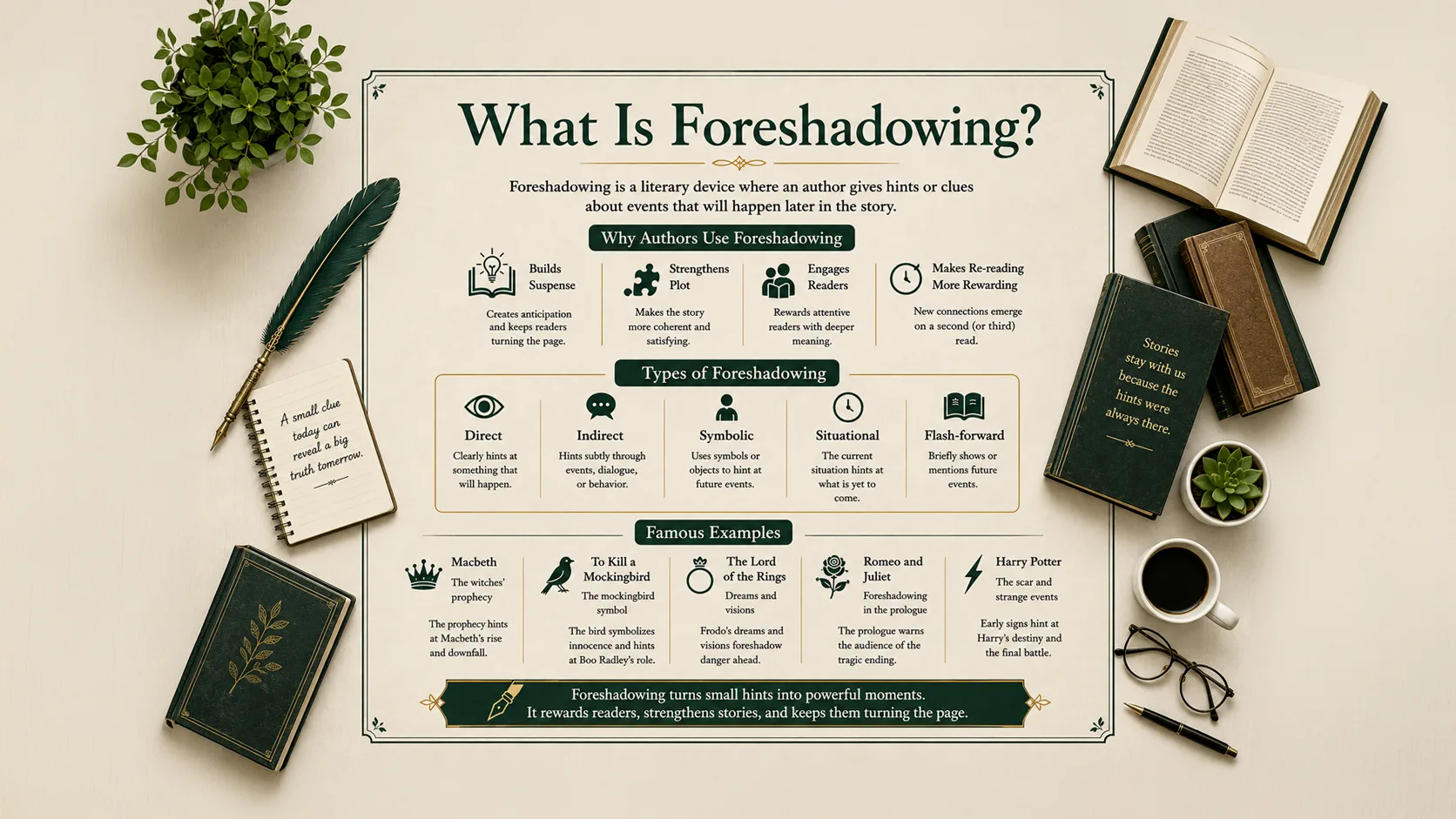
Your cover makes a promise to a reader, and your book has to keep it. If your story hinges on a tension between a hero and a rival, a cover that hints at that conflict can be powerful, and understanding the protagonist vs antagonist dynamic helps you decide which figure, if any, should appear. Subtle hints in a design can also nod to later story events, which is where foreshadowing works as well visually as it does on the page. For emotionally driven books, knowing what pathos is can help you pinpoint the feeling a cover should evoke, and if you like to describe your book in figurative language, these metaphor examples can sharpen the way you talk about it.
Supply the technical details
Tell your designer the format (ebook, paperback, hardback), the trim size, the final page count, the paper type and the platform you'll print and sell through. Page count matters because it determines spine width. Give them your back cover copy and any text that has to appear, such as a quote or series line. Make sure it's proofread first, because errors on a cover are painful and costly to fix. A book proofreading service can catch those before the design is locked.
Agree the terms in writing
Before design starts, agree the number of revisions, the timeline and the list of deliverables. Those three things prevent most disputes. Write them down, even if it's only an email you both confirm.
How Do You Compare Book Cover Quotes Fairly?
To compare cover quotes fairly, put them side by side in a simple grid and check the same six things for each: formats covered, revision rounds, files delivered, licences included, ownership terms and timeline. Once every quote is measured against the same list, the price differences usually explain themselves.
Let's go back to Aoife. Her three quotes looked wildly different, so she made a short table in a notepad. The first designer included an ebook cover and a paperback wraparound, two revision rounds, the layered file, and written confirmation that she'd own the artwork. The second offered an ebook cover only, with one revision and no mention of licences. The third was a single line that said "cover design" and nothing else.
Suddenly the picture was clear. The first quote wasn't expensive; it was complete. The second was lighter because the job was lighter. The third wasn't a quote at all, because it told her nothing she could rely on. She went back to the second designer, asked for a paperback add-on and a licence summary, and found the two quotes landed much closer together than they first appeared.
A simple checklist you can copy
Does the quote name every format you need?
How many revision rounds are included, and what happens if you need another?
Which files will you receive at handover?
Are image and font licences included, and can they be transferred to you?
Does the contract say you own the artwork, or only licence it?
What's the timeline, and what does the designer need from you to keep to it?
How long should a cover take?
Timelines vary with complexity, but a realistic project includes a briefing stage, a concept stage, revisions, and final file preparation. A premade cover can be ready quickly because the design already exists. A fully illustrated cover takes longer because the artwork is created from nothing. If a designer promises something far faster than usual for a complex brief, ask what's being skipped. Build some breathing room into your launch schedule so a delayed review or an extra round of changes doesn't push your publication date.
Test your favourite design at thumbnail size
Before you approve a final cover, shrink it to the size it will appear in an online store and look at it on your phone. Can you still read the title? Does the image still make sense? Many covers that look wonderful full size turn into a muddle when reduced. Asking your designer for a thumbnail preview is perfectly reasonable, and it's one of the most practical checks you can make before signing off.
How Do You Spot a Book Cover Quote That's Not Worth Paying For?
A quote deserves a second look when it guarantees sales or bestseller status, arrives as a lump sum without a breakdown, avoids confirming copyright transfer, is vague about image licences, or sits so far below the market that the only way the economics work is by cutting corners you'll pay for later.
Guarantees about sales
No designer can promise reader behaviour. A cover can improve your chances by fitting its genre and standing out at thumbnail size, but sales depend on the book, the blurb, the reviews and your promotion too. Be cautious of any claim that a cover will make you a bestseller.
Lump sums with no detail
If you're given one number with no explanation, ask for an itemised version. What formats are included? How many revisions? Are source files and licences part of the price? Without that detail, you can't compare quotes fairly, which was exactly Aoife's problem at the start of this guide.
No written confirmation of ownership
If a designer won't say in writing that you own the cover, or won't grant a clear licence, walk away. This is one of the most common gaps in very cheap covers, and it's one you'll only discover when you try to reuse the artwork.
Vague image licensing
You should know where each image came from and what licence covers it. If the designer can't or won't tell you, you may be building your book on shaky ground. A licence problem discovered after publication can force a recall and a redesign.
A price far below the market
Very low prices usually have an explanation. Maybe the designer uses a template that many other authors also buy. Maybe the images aren't properly licensed. Maybe an AI-generated base has been used without disclosure. The saving is real on the day, and expensive later.
Pressure to pay a large deposit upfront
A reputable designer will happily discuss your brief, show you relevant portfolio work, and explain their process before asking for a large payment. Pressure to commit before you've seen anything relevant to your genre is a warning sign.
Missing portfolio or technical know-how
Ask to see covers in your genre. Ask how they'll prepare files for the platform you're using. If they can't answer, a technical rejection on upload becomes your problem rather than theirs.
No contract
Finally, if there's no written agreement at all, that's the biggest warning of the lot. The brief, deliverables, revisions, timeline, ownership and licensing should all be set out before money changes hands.
What Else Sits Around Your Cover in the Publishing Process?
A cover is one piece of a longer production chain, and it works best when the pieces around it are ready. If you're still developing your manuscript, ghostwriting services can help shape an idea into a finished draft. Once the text is written, editing and proofreading come next, then formatting, then the cover, then printing or digital distribution.
After your cover is finished, it becomes the visual anchor for everything else. An author website can showcase it alongside your bio, extracts and a way for readers to sign up for updates. A book video trailer often builds on the cover's artwork and colour scheme. And when you're ready to put money behind promotion, it helps to understand how much book marketing costs so you can plan a realistic budget alongside your design spend. For a wider look at promotional options, see the book marketing services overview.
Thinking about the whole chain at the start makes your cover decisions easier, because you'll know what's still to come and what needs to stay consistent. A cover isn't an isolated purchase. It's the face of a project.
Conclusion
Book cover design cost in Ireland isn't one number. It's the sum of a few clear choices: the type of cover, the format, the designer's working model, and the rights and files you receive at the end. Once you understand those, a quote stops being a mystery and becomes something you can check, question and compare.
For Irish authors, the local details matter most. Ask whether VAT is included, remember that the Artists' Exemption doesn't reduce production costs, and weigh an Irish designer against an overseas one by looking at the whole picture, not just the headline figure. Get ownership, image licences and source files in writing before any money moves.
Brief your designer well, test the cover at thumbnail size, and treat red flags as reasons to pause rather than reasons to feel pressured. A cover that fits its genre, reads clearly on a phone and is legally yours to use will serve your book for years.
Ready to Plan Your Book Cover Design Budget?
The next step is a direct conversation about your book, your genre and the format you need, because that's where a tailored quote starts, rather than a generic package. If you'd like a clear, written quote for your cover that sets out formats, revisions, licences and ownership, get in touch with the team at Ireland Publishing House and tell us about your book.
You'll come away with a straight answer to what a cover for your specific book should cost in Ireland, with VAT and licensing out in the open rather than hidden in the small print. Bring your page count, your genre and a few covers you love and, ideally, your preferred launch date, and the conversation will be much quicker and more useful for both sides.