You've heard someone say "that's so ironic" about something that was really just bad luck. Maybe you've nodded along, secretly unsure whether they were right. Or you've tried to explain the difference between verbal and situational irony to a friend and ended up more tangled than when you started.
You're not alone. Irony is one of the most misused terms in the English language, and most guides only tell you half the story. They'll cover verbal, situational and dramatic irony, then stop, leaving out Socratic and cosmic irony entirely, as though they don't matter.
They do. This guide covers all five, with definitions that actually make sense, examples that go beyond Shakespeare and Alanis Morissette, and practical advice for using irony in your own writing. By the end, you won't just be able to spot irony in a novel or a film. You'll know how to build it into your own work on purpose, which is a very different skill.
Let's get into it.
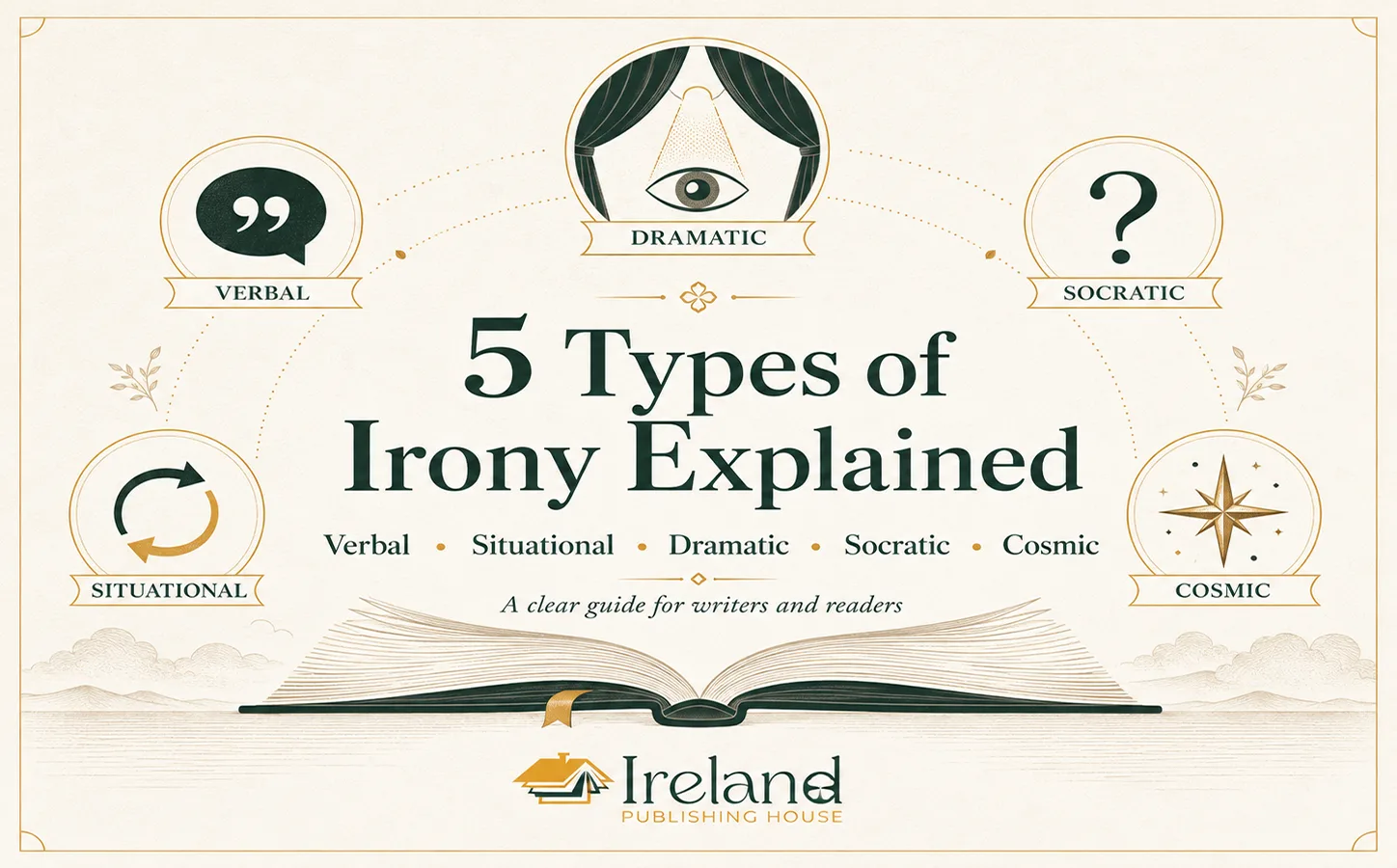
The Five Types of Irony at a Glance
Here's a quick-reference table before we go section by section. Every type of irony hinges on a gap: between what's said and what's meant, what's expected and what happens, or what the audience knows and what the characters know.
Type of Irony | Core Gap | Operates At | Primary Effect | Example |
Verbal Irony | Between what is said and what is actually meant | Word or phrase | Humour, criticism, or emphasis | Saying "what glorious weather" during a downpour |
Situational Irony | Between what's expected and what actually happens | Event or outcome | Surprise, poignancy, or dark comedy | A fire station burning to the ground |
Dramatic Irony | Between what the audience knows and what the characters know | Scene or whole narrative | Suspense, tension, or tragic inevitability | The reader knows the letter never arrived, but the character keeps waiting for a reply |
Socratic Irony | Between a questioner's feigned ignorance and their real knowledge | Dialogue or argument | Exposing flawed logic or hypocrisy | A teacher asking "so, what exactly do you mean by that?" already knowing the answer won't hold up |
Cosmic Irony | Between human effort and an indifferent universe or fate | Theme or whole work | A sense of futility, tragedy, or dark humour | A man spends his life avoiding a prophecy and fulfils it through the very act of avoiding it |
Bookmark this table. We'll unpack every row of it below.
What Is Irony, Really?
Irony is a gap between appearance and reality, or between what's expected and what actually happens. It's not just a surprise. A surprise can be neutral. Irony carries meaning, it makes you reconsider what you thought you knew, and that reconsideration is where the power comes from.
The word gets stretched to cover almost anything unfortunate or coincidental these days, which is exactly why so many people misuse it. Rain on your wedding day isn't ironic. It's just rain, and bad timing. The Oxford Research Encyclopedia of Literature frames irony as a rhetorical and narrative device built on contrast and incongruity, not on misfortune alone, and that distinction matters more than most casual usage admits.
Irony isn't purely academic, either. It's how writers create humour without stating a joke outright, how they build suspense without spelling it out, and how they land a gut-punch of tragedy that a direct statement never could. Jonathan Swift understood this better than almost anyone: "A Modest Proposal" doesn't announce that its narrator is being monstrous, it lets the gap between his calm, reasonable tone and his horrifying suggestion do the work. That's irony operating at full strength.
Expert Tip: Study the writers who built entire careers on it. Jane Austen for verbal irony, O. Henry for situational, Christopher Nolan for dramatic. Reading how they deploy the device is worth more than any definition on its own.
Why Your Brain Actually Enjoys the Twist
There's a reason irony feels satisfying rather than just confusing. When a reader detects the gap between what's expected and what's delivered, the brain runs a small piece of social and cognitive processing, essentially working out what the speaker or the situation "really" means, and resolving that gap carries a small reward of its own. It's a similar mechanism to what makes a well-built joke land: setup, misdirection, payoff.
That's also why badly signposted irony falls flat. If you tell the reader outright that a line is ironic, you skip the resolution step entirely, and the brain never gets to do the bit of work that makes the payoff feel earned. Writers who understand this instinctively, even without knowing the cognitive science behind it, tend to be the ones whose ironic lines actually get quoted back to them years later.
Deep Dive: Verbal Irony
Definition and How It Works
Verbal irony happens when a speaker says something that contrasts with what they actually mean, often the direct opposite. It isn't the same as lying, because tone and context signal the real intent. The listener is meant to catch the gap between the words and the meaning, and that gap is where the humour, the criticism, or the emphasis lives.
LitCharts describes verbal irony as saying one thing while meaning another, distinct from dramatic or situational irony because it happens at the level of language rather than event or plot. That's the cleanest way to keep it separate from the other four types: if the gap is in the words themselves, you're looking at verbal irony.
The Three Subtypes
Verbal irony isn't one flat category. It splits into three recognisable forms.
Sarcasm is the sharpest, most mocking version. "Oh brilliant, another Monday morning meeting" isn't really praising the meeting, it's criticising it, and the speaker wants you to know that.
Understatement downplays something significant on purpose. After a house fire, saying "we've had a small setback" is ironic precisely because the reality is so much worse than the words suggest.
Hyperbole exaggerates for ironic effect. "I've told you a thousand times" isn't a literal count, it's a frustrated overstatement that highlights how the speaker actually feels.
You'll see this constantly on social media now too. A TikTok caption reading "this is fine" over footage of total chaos is verbal irony doing exactly what it's always done, just in a new format.
Classic and Modern Examples
Jane Austen built her entire narrative voice on verbal irony. In Pride and Prejudice, Mr Bennet's polite, weary comments about his wife's nerves read as courteous on the surface while quietly skewering her. Closer to home, Oscar Wilde made a career out of it. In The Importance of Being Earnest, characters deliver devastating social critiques wrapped in perfectly pleasant conversation, which is precisely why the play still lands with audiences well over a century later.
On screen, Michael Scott in The Office (US) leans on a cruder version of verbal irony every time he says "that's what she said," twisting an innocent line into something else entirely. The joke only works because the audience catches the gap he's exploiting.
How to Use Verbal Irony in Your Own Writing
Make sure context does the signalling. If a reader genuinely can't tell you're being ironic, they'll take the line at face value and the whole effect collapses.
Use it sparingly. A narrator who's ironic in every sentence starts to sound smug rather than sharp.
Resist the urge to explain it. Writing "ironically, she said she loved it" kills the joke before the reader gets to enjoy it. Trust the tone and the situation to carry the weight instead.
If you're working through a manuscript and want a second opinion on whether your tone is landing the way you intend, a tool like Grammarly's tone detector can flag lines that might read as sincere when you meant them as ironic, which is a useful gut check before you send a draft to beta readers.
Expert Tip: Never signal irony with phrases like "ironically" or "it was ironic that." Let the contrast speak for itself.
Deep Dive: Situational Irony
Definition and the Coincidence Trap
Situational irony is an outcome that's the opposite of what was expected, a twist that feels surprising in the moment and inevitable in hindsight. The most common mistake writers and readers make is confusing this with plain coincidence or bad luck.
A flat tyre on the way to a job interview is bad luck. It has no built-in reversal of expectation. But if you're a mechanic who specialises in tyre repair and you're the one stuck on the side of the road, that's situational irony, because the outcome directly contradicts what your profession would lead you to expect.
Examples From Literature and Film
O. Henry's "The Gift of the Magi" is the textbook case: a wife sells her hair to buy a chain for her husband's watch, while he sells his watch to buy combs for her hair. Both gifts become useless the moment they're exchanged, and that mutual, well-meaning sacrifice is what makes the ending ache rather than simply surprise.
Closer to the present, Breaking Bad runs almost entirely on situational irony. Walter White starts cooking meth to secure his family's financial future after a cancer diagnosis. By the finale, his choices have destroyed the very family he claimed to be protecting. The expectation, provide for them, gets brutally reversed by the means he chose to achieve it.
Get Out does something similar in a single, tighter arc. The protagonist's attempt to escape a conspiracy leads him directly into its trap, which is situational irony working at the level of an entire plot rather than a single scene.
Crafting Situational Irony in Your Own Plot
Set the expectation clearly before you subvert it. Readers need to genuinely believe in the likely outcome, or the twist won't land as a reversal at all.
Make the reversal feel earned rather than random. The best situational irony feels inevitable once you see it, not like a coin flip the author forced.
Use it to say something about character or theme, not just to surprise. A twist that only exists to shock the reader rarely stays with them. One that reveals something true about human nature does.
Expert Tip: Set up expectations clearly before subverting them. The twist should feel surprising yet inevitable, never arbitrary.
Deep Dive: Dramatic Irony
Definition and the Suspense Distinction
Dramatic irony occurs when the audience knows something that one or more characters don't. That knowledge gap creates tension, dread, or dark comedy, depending on what's at stake.
It's easy to confuse this with suspense, but they're not the same mechanism. Suspense runs on uncertainty, we don't know what's about to happen. Dramatic irony runs on certainty, we know exactly what's coming, and we watch, often helplessly, as a character walks straight towards it anyway.
How It Works Across Genres
In tragedy, Romeo and Juliet is the classic case: the audience knows Juliet is only sleeping, but Romeo believes she's dead, and his despair drives the play's final catastrophe.
In horror, Jaws uses the same structure to different effect. We see the fin cutting through the water while swimmers splash on, oblivious, and that gap between what we know and what they don't is what makes the scene unbearable to watch.
In comedy, sitcoms rely on it constantly. When the audience already knows about a misunderstanding before a character does, their eventual, pompous reaction becomes funnier precisely because we've been waiting for it.
Techniques for Managing the Gap
Reveal the crucial information to your reader early. Plant it deliberately so they feel like they're "in the know" before the character catches up.
Don't over-explain the gap once it's there. Trust your reader to feel the tension without a narrator spelling out "if only she knew."
Use dramatic irony to build empathy as much as dread. Knowing something a character doesn't can make a reader root for them just as easily as it can make them brace for disaster.
Expert Tip: Reveal crucial information to your reader early to build suspense, but avoid over-explaining the gap once you've planted it.
Deep Dive: Socratic Irony
Definition and Historical Origins
Socratic irony is feigned ignorance used to expose flaws in someone else's argument. It takes its name from Socrates, who would pretend not to understand a concept in order to draw his conversation partners into contradicting themselves. It's less a literary device in the traditional sense and more a tool of philosophical inquiry, though it's found its way firmly into fiction and dialogue writing since.
In Plato's dialogues, particularly the Republic and the Euthyphro, Socrates repeatedly asks seemingly naive questions about justice or piety, pretending not to know the answers, until his companions realise their own definitions don't hold together.
Examples From Philosophy and Fiction
The technique translates well to modern character work. In House, Dr House regularly asks questions that sound naive but are actually designed to force his team to confront a flawed diagnosis they've talked themselves into believing.
You'll spot the same pattern in political interviews, where a journalist asks a deceptively simple question, "could you just walk me through that figure again?", that ends up exposing a contradiction the politician never intended to reveal.
Using Socratic Irony in Your Own Dialogue
Have the questioning character genuinely appear to feign ignorance. If they come across as smug rather than curious, the technique reads as bullying instead of illumination.
Use it to reveal character flaws organically. The other person's answers, not the questioner's cleverness, should be what exposes the arrogance or the shallow thinking underneath.
Keep the goal as illumination, not humiliation. A questioner who's clearly just trying to win will feel less interesting than one genuinely drawing out the truth.
Expert Tip: When writing Socratic irony into dialogue, have the questioner feign ignorance to expose the other character's flawed logic, not to score a cheap point.
Deep Dive: Cosmic Irony
Definition and the Role of Fate
Cosmic irony, sometimes called irony of fate, happens when a higher force, fate, the universe, an indifferent god, seems to work against human hopes and effort, delivering an outcome that's cruelly opposite to what was intended. It's the sense that the deck was stacked from the start, and that struggling against it only tightens the trap.
Robert Burns captured the same idea outside of fiction entirely in "To a Mouse," with the line about the best-laid schemes going awry regardless of how carefully they were made. That's cosmic irony in miniature: effort and outcome pulling in opposite directions no matter how hard anyone tries.
Examples From Classic and Contemporary Work
Oedipus Rex is the foundational example. Oedipus spends the entire play trying to avoid a prophecy that he'll kill his father and marry his mother, and every single action he takes to escape it brings him closer to fulfilling it.
Samuel Beckett, working from a very different tradition, built an entire body of work around a related idea, that human effort and meaning-making persist in a universe that offers no guarantee either will matter, which is cosmic irony stretched across an entire philosophy rather than a single plot twist.
In No Country for Old Men, Llewelyn Moss finds drug money and takes it, hoping to secure a better life. Instead, he sets off a chain of events that ends in his death, while the universe of the story remains entirely indifferent to the outcome.
Thematic Power and When to Use It
Cosmic irony works best in tragedy, or in stories with a genuinely philosophical bent, because it needs room to breathe thematically rather than functioning as a quick plot beat.
Tie it to theme deliberately. It should highlight the limits of human agency, not just deliver a downbeat ending for its own sake.
Be careful it doesn't slide into nihilism unless that's exactly the effect you're after. The strongest cosmic irony leaves the reader with a sense of poignant inevitability, not blank despair.
Expert Tip: Cosmic irony works best in tragedies or stories about fate. Use it to highlight the futility of human effort against forces larger than any single character.
Common Mistakes and Misconceptions
Irony vs. Coincidence: A coincidence is two things happening at the same time by chance, nothing more. Irony requires an expectation that gets reversed. Bumping into your ex at a café is a coincidence. Bumping into your ex while you're on a date and mid-sentence about how you never run into them anymore, that's situational irony.
Irony vs. Bad Luck: Getting rained on during a picnic is bad luck. A meteorologist who confidently predicted sunshine getting rained on during their own picnic is situational irony, because their profession creates the expectation that gets undercut.
Irony vs. Sarcasm: Sarcasm is a form of verbal irony, but not every instance of verbal irony is sarcastic. Sarcasm is usually meant to wound or mock. Verbal irony can be gentler than that, even affectionate. Saying "grand day for it" during a downpour is verbal irony. Saying it with a sneer at someone who's just complained about the weather tips it into sarcasm.
Irony vs. Paradox: A paradox is a statement that seems self-contradictory but may still hold a truth, "less is more" is the classic example. Irony is a gap between expectation and reality, not a logical contradiction, and the two shouldn't be used interchangeably even though they sometimes get lumped together.
Writing coaches see these mixed up constantly in manuscripts. If you're working through a draft and want a second pair of eyes on whether a twist actually functions as irony or just reads as an unfortunate event, that's exactly the kind of note a professional manuscript editor will catch before a reader does.
How to Use Irony in Your Writing: Practical Tips
General Principles
Let the contrast speak for itself. The moment you explain the irony directly, you've done the reader's job for them, and the effect flattens out.
Test it on real readers. If several people miss the irony entirely, the setup probably needs strengthening rather than the payoff needing more emphasis.
Combine types for a layered effect. Dramatic irony can heighten the impact of a situational twist, for instance, when the reader already knows the reversal is coming before the character walks into it.
Expert Tip: Combine types of irony for layered effect. Dramatic irony stacked on top of a situational twist tends to land harder than either used alone.
Dos and Don'ts by Type
Verbal: Do let context clarify intent. Don't overuse it, or your narrator starts to sound insufferable rather than sharp.
Situational: Do set up expectations clearly. Don't lean on coincidence, the twist has to feel earned, not accidental.
Dramatic: Do reveal information to the reader early. Don't let characters behave stupidly purely to keep the gap open longer than it should stay open.
Socratic: Do use it to reveal character. Don't turn the questioner into a mouthpiece for your own cleverness as the author.
Cosmic: Do tie it to theme. Don't reach for it as a shortcut to tragedy without earning it through character choices.
A Few Exercises Worth Trying
Rewrite a scene from a favourite novel or film, adding one type of irony that wasn't there originally, and see how it changes the tone.
Keep an irony journal for a week. Jot down every real instance you notice, in conversation, on television, on your phone, and sort each one into its type.
Write a short piece of dialogue where one character uses Socratic irony to expose another's hypocrisy without ever stating the contradiction outright.
If you want a structured environment to actually practise these exercises rather than scribbling them into a notes app and forgetting them, Reedsy Studio's free writing tools are worth a look, and courses through The Novelry cover literary devices like irony in more depth if you want formal instruction alongside the practice.
Test Yourself: Can You Identify the Type of Irony?
Read each short scenario and decide which type of irony is at play before checking the answer underneath.
1. A traffic cop gets his own driving licence suspended over unpaid parking tickets.
Answer: Situational irony. His role creates the expectation that he'd be the last person to end up in that position.
2. In a horror film, the audience watches the killer hide in the closet while the protagonist walks straight through the front door instead.
Answer: Dramatic irony. The audience knows something the character doesn't, and that gap is where the tension comes from.
3. During a debate, a politician asks her opponent, "could you explain your economic plan again? I'm just a simple voter trying to follow along," while knowing exactly where the plan falls apart.
Answer: Socratic irony. The feigned ignorance is a tool to expose the other side's weak logic.
4. A character spends his entire life trying to avoid a prophecy, only to fulfil it through the very actions he takes to escape it.
Answer: Cosmic irony. Fate wins regardless of, or because of, the effort spent fighting it.
5. "I love it when my laptop crashes right before I hit save on a three-hour project," you mutter through gritted teeth.
Answer: Verbal irony. You obviously don't love it, the words and the meaning are running in opposite directions.
If you got most of these right, you've already internalised the gap-based thinking that makes irony work. If a couple caught you out, that's genuinely normal, the line between situational and dramatic irony in particular trips up even experienced readers.
Irony From Ancient Greece to Modern Media
The device is roughly 2,500 years old and it hasn't slowed down.
It starts with Socratic irony in Plato's dialogues and dramatic irony in Sophocles' tragedies, where entire plots rest on the audience knowing what the characters don't. Shakespeare picks up dramatic irony and runs with it in Romeo and Juliet, while working verbal irony into the wordplay of comedies like Much Ado About Nothing. Jane Austen and Oscar Wilde carry verbal irony through the nineteenth century, and O. Henry becomes the go-to name for situational twists not long after. By the twentieth century, cosmic irony finds its fullest expression in Thomas Hardy's tragedies and later in film noir, where fate always seems to be one step ahead of every character trying to outrun it.
Then the internet happens, and irony changes shape again. Post-irony, memes, and shows like BoJack Horseman blend sincerity and sarcasm so thoroughly that audiences sometimes genuinely can't tell which one they're looking at. That's not a failure of the device. It's irony adapting to a medium built on rapid, layered, often anonymous communication, and it's exactly why understanding the fundamentals still matters. Once you know the five types cold, spotting them in a meme is no different from spotting them in Sophocles.
Post-Irony and the Confusion It Creates
Post-irony is what happens when irony gets used so often, and so casually, that audiences can no longer be certain whether a statement is sincere, ironic, or a deliberate blend of both. A meme captioned "living my best life" over a photo of obvious chaos might be straightforward verbal irony. Posted again a week later, in a different context, the exact same caption might be entirely sincere. The words haven't changed. The layer of intent behind them has.
This matters for writers because online audiences, particularly younger ones, have effectively been trained on irony as a default mode of communication rather than an occasional device. That's a shift worth understanding if you're writing contemporary fiction with characters who communicate the way real people online actually do, or if you're building marketing copy for a book and trying to strike a tone that reads as knowing rather than naive. Get the balance wrong and you risk a line landing as sincere when you meant it as a wink, or vice versa, which is exactly the kind of gap this guide has spent the last several sections teaching you to control on purpose rather than by accident.
Writing Irony Into Your Own Book
Understanding irony as a reader is one thing. Building it into a manuscript, and having it survive contact with actual readers, is another skill entirely, and it's one that benefits enormously from a second set of trained eyes.
A developmental edit is often where situational and dramatic irony either click into place or fall apart, because both depend on structure: what the reader knows, when they know it, and how the reveal is paced across the whole book. If you're working on longer fiction, ghostwriting support or dedicated fiction ghostwriting can help you get a twist-driven plot onto the page in the first place, particularly if you know the shape of the irony you want but you're struggling to execute it cleanly across chapters.
Once the manuscript exists, proofreading and formatting make sure none of that careful set-up gets undermined by a typo landing right on your punchline or a layout issue burying your reveal on an awkward page break. If your book leans on visual irony too, a mismatched cover promising a comedy when the ending is genuinely cosmic in scope, working with a book illustration team or a design studio that understands tonal nuance will save you from sending the wrong signal before a reader even opens the book.
For non-fiction writers using irony to make an argument land, or for authors building out promotional material, a well-cut book video trailer or a broader marketing push can carry that same ironic tone through to readers before they've even bought the book. And if you're building a long-term author brand around a distinctive voice, a dedicated author website gives that voice somewhere permanent to live.
Whatever format you're heading towards, whether that's a print run through book printing, an audiobook where vocal tone carries the ironic weight a reader would otherwise pick up from the page, or a title going out through Amazon Kindle publishing, the underlying craft is the same: set the expectation clearly, then let the reversal do its work without over-explaining it.
If you're introducing younger readers to the idea of irony, it's worth knowing this isn't purely an adult-fiction concern either. Children's book publishing has its own gentle version of situational irony, think of a picture book where the character who's afraid of the dark ends up being the one who saves the day using it, and getting that balance right for a younger audience takes just as much care as it does in literary fiction.
Whatever stage you're at, from a Socratic exchange in your dialogue to a full cosmic-irony ending, Ireland Publishing House works across the full publishing process to help Irish authors get that kind of nuance right, rather than leaving it to chance.
Irony is closely related to other figurative devices too, and if you want to see how it sits alongside metaphor, hyperbole and understatement more broadly, our piece on figurative language is a natural next read. Poets working in the Irish tradition in particular tend to lean on irony constantly, often folded into the same lines as other poetic techniques, so it's worth studying the two together rather than in isolation.
If your irony hinges on a first line or a first chapter doing double duty, promising one thing while quietly setting up its reversal, our guide to writing a first chapter covers how to plant that kind of set-up without tipping your hand too early. And if you're quoting other authors' work as examples of irony in your own writing, it's worth understanding the basics of copyright law in Ireland before you lift lines wholesale.
Once your manuscript is ready to go out into the world, our roadmap to self-publishing in Ireland and our broader guide on how to publish your book in Ireland walk through everything that comes after the writing is done.
Now that you've got all five types straight, try spotting them in your next binge-watch or your next conversation. Then, when you're ready, start weaving them deliberately into your own work. The twist is in your hands.